One day this past summer, I watched my dog lay beneath my fig tree. She rested her gold-colored head between her forepaws and shut her eyes. I laughed to myself, thinking how easy she had it. I fed her every day, gave her water, took her on walks, played with her–essentially, I provided for her every need, and she was contented.
We who know God have it made, too, if we would just learn to be content. But it’s hard to be content with the world hawking its luxuries. Every time we visit a shopping mall or turn on the TV, we’re bombarded with temptations to buy things we don’t need. Don’t misunderstand me. Nothing’s wrong with owning a few luxuries, so long as we’re not discontented with God’s provision. It’s the grasping hand God frowns upon, the compulsion to want more. “And if we have food and covering, with these we shall be content,” Paul said in 1 Timothy 6:8 (NAS). If this is true of animals like my dog, how much more should it be true of us.
Copyright Jack Cunningham. Originally published in Evangel, August 9, 1999. Free Methodist Church, Light and Life Communications.
On a high limestone bluff overlooking the Alabama River, two hundred cabins and eighty wigwams provided a refuge for the Red Sticks after the Fort Mims massacre as well as a headquarters for Chief William Weatherford and other chiefs. In the center of the town stood a pole from which hundreds of scalps hung, trophies from Fort Mims’s dead.
Surrounded by the river, two creeks, a swamp and forests, not a single road or path led into it. Called Ecunchate (Ikanachaki) in the Creek language and the Holy Ground in the Americans’ English, Josiah Francis and his prophets did incantations over it, putting a magical barrier around it, they believed. They claimed it would protect them from every white man who dared set foot on its sacred soil. If only for a few months, the Holy Ground was a haven for them. It would soon become General Ferdinand Claiborne’s objective when he launched his offensive to avenge the massacre.
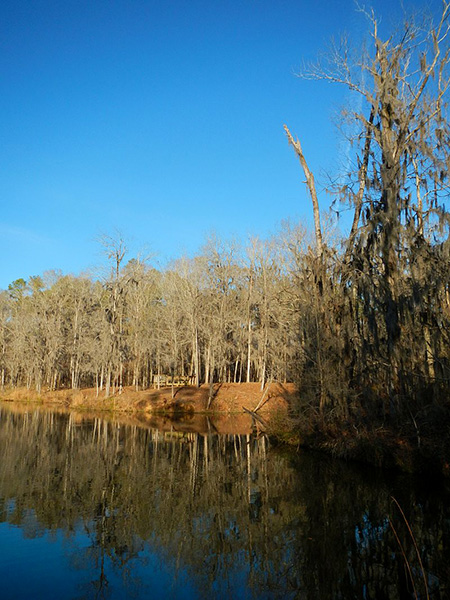
Holy Ground Battlefield Park, photo by Rivers Langley
When General Thomas Flournoy, commander of the Mississippi Territory’s Seventh Military District, ordered General Claiborne to march up the Alabama River to Weatherford’s Bluff, named for William Weatherford’s father Charles, Claiborne’s offensive started.
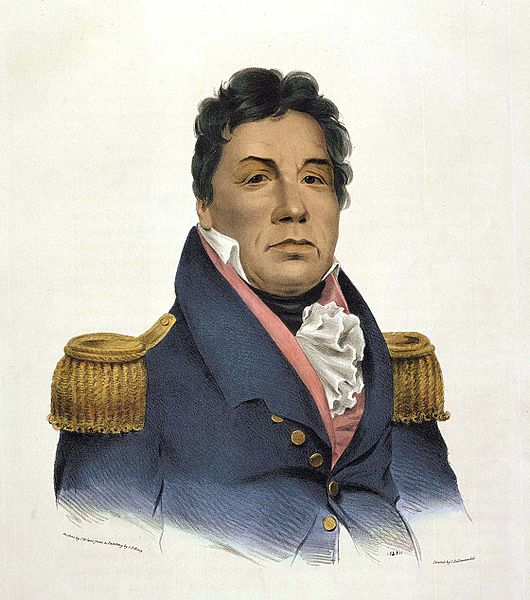
On November 17, Claiborne arrived at the bluff then crossed the Alabama on rafts, built another stockade (Fort Claiborne), and awaited reinforcements from Generals Floyd and Jackson. A small detachment of Choctaws under Pushmataha, who’d been given the rank of lieutenant colonel, accompanied him.
When Colonel Gilbert Russell’s Third U.S. Regiment arrived, Claiborne sought General Flournoy’s permission to advance against the Holy Ground. Although eager to attack it, many of his officers, respectfully, signed a petition in protest. The reasons they cited: no winter clothes, no shoes, no blankets, no roads. Eventually, however, Claiborne persuaded them to his way of thinking.
Sam Moniac, Weatherford’s brother-in-law who’d whacked Josiah Francis with Francis’s warclub months earlier, served as Claiborne’s guide. Due to Moniac’s service during the Creek War his son, David, would be accepted into West Point and become one of its first minority graduates.
On December 13, Claiborne resumed his march for eighty miles, built another stockade, and on December 22 headed deeper into the Creek nation. Upon spotting Claiborne’s army, Weatherford hastened back to the Holy Ground to prepare for the pending attack. Francis and some other Creeks fled at the news, reducing the number of Creeks and escaped slaves to defend the town.
The Battle of the Holy Ground
General Claiborne’s Tactics
Claiborne planned a three-pronged attack, each column with a different objective, and he sent a fourth force across the river to cut off the Red Sticks’ retreat. Of these three columns, only the right column under Colonel Joseph Carson engaged in major fighting. He was ordered to cross Holy Ground Creek and then attack the Holy Ground’s upper town. The left column, under Major Benjamin Smoot, had the objective of capturing the Holy Ground’s lower town while General Claiborne and Colonel Russell held the center in reserve. Major Cassel’s men, the fourth force, was assigned the job of cutting off the Red Sticks’ retreat.
William Weatherford’s Tactics
When Josiah Francis ran away, Weatherford assumed command. First, he ordered that the women and children be taken across the river in canoes to the safety of the thick woods. Many prophets argued with him and protested, insisting their magic barrier would protect them. Fortunately, Weatherford asserted his authority and got his way, and the noncombatants were rushed to safety.
Next, since he anticipated an attack would come across Holy Ground Creek, he set up an ambush. Warriors with rifles, he posted behind a stream bank while others hid behind a fallen tree to await the Americans. A third body of men, wielding bows and arrows, he placed in the rear.
William Weatherford Becomes a Legend
Colonel Carson’s troops made the major attack across Holy Ground Creek. At first, due to the Red Sticks’ withering barrage and stiff resistance, their advance was slow. Men fought from behind trees and stumps, arrows flew high and beyond them to no effect. When the troops finally flanked the Red Sticks, the warriors beat a retreat back toward their town, many having fallen to the soldiers’ bullets.
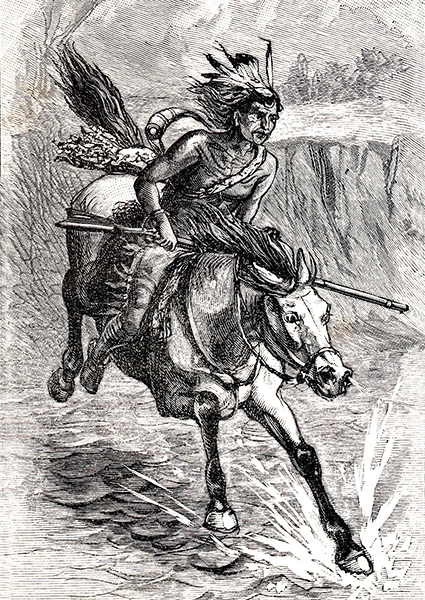
Weatherford raced to his swift steed Arrow, mounted him and found himself facing Carson’s men practically alone. Surrounded. No escape. He was going to be captured. He galloped to the riverbank, to a bluff about fifteen feet high. Pretty long way down into the river. Could he make it? He had no choice. It was either leaping into it or else being captured or killed.
He turned Arrow back and moved quickly up a hollow to give his powerful horse a good running start. Then he galloped back down and leaped off the bluff, diving into the river. Arrow surfaced and swam to the other side amidst musket balls splashing around them. Both Weatherford and Arrow made it to shore, out of the range of Carson’s troops, unhurt.
Claiborne’s army spent a cold Christmas Eve camped on Weatherford’s plantation, in his cornfield, dining on boiled acorns and parched corn—all the food they had. By January 14, the general’s army had dwindled to sixty volunteers, for the other soldiers’ enlistments had expired. In Weatherford’s house, a letter from the Spanish governor of Pensacola was found, congratulating him on the victory at Fort Mims and a suggestion that he attack Mobile — clear evidence of Spain’s role in the war. What this governor did not know, however, is that Weatherford could neither read nor write because he’d had no desire to ever learn.
Did Weatherford and Arrow Really Make Their Legendary Leap?
Some people have questioned whether Weatherford and Arrow actually made their famous leap. No historian has been able to disprove it and according to Benjamin W. Griffith, Jr., in his book McIntosh and Weatherford, Creek Indian Leaders, the consensus among eyewitnesses, such as Sam Moniac and Sam Dale, and most of those who knew Weatherford is that a leap did occur. Because this feat moved William Weatherford into Alabama legend, some accounts have exaggerated certain aspects of it, such as the height from which he and Arrow jumped. According to the Encyclopedia of Alabama, fifteen feet is about the true height.
Sources
Griffith, Benjamin W. Jr. McIntosh and Weatherford, Creek Indian Leaders, Tuscaloosa and London: The University of Alabama Press, 1988.
Pickett, Albert J. The History of Alabama. Republished by Birmingham Book & Magazine Co. of Birmingham, Alabama, 1962. Copyright 1878 by Mrs. Sarah S. Pickett.
Waselkov, Gregory A. A Conquering Spirit: Fort Mims and the Redstick War of 1813-1814. Tuscaloosa: University of Alabama Press, 2006.
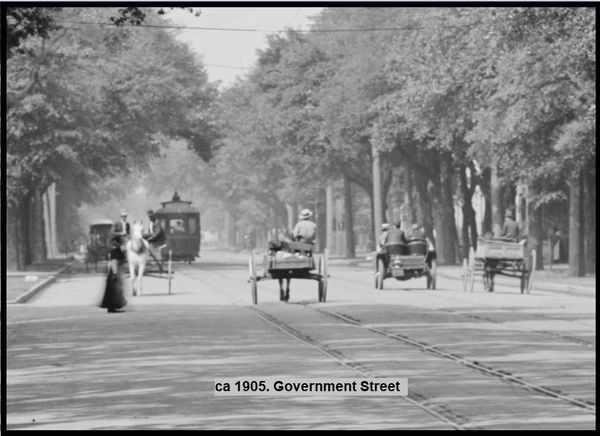
Government Street is one of the oldest streets in Mobile and a main artery going through its downtown section.
REAL SETTINGS/FICTIONAL NAMES
William Faulkner: In many of his works, Faulkner set his tales in fictional Yoknapatawpha County, inspired by the Mississippi county, Lafayette, in which he lived.
Winston Groom: One of Winston Groom’s early works, Gone the Sun, is partially set in the town of Bienville. However, having grown up in Mobile the same as he did, and in the same era, it was obvious to me that his fictional Bienville is— actually – Mobile!
So, Faulkner and Groom show us that it’s perfectly fine to use a real setting but give it a different name. This allows writers lots of freedom—where their characters go, where events happen, and the types of characters they use.
REAL CITIES/REAL NAMES
Research: If a writer knows his/her setting well, he or she doesn’t have to do lots of research. However, detailed research is essential if stories have a real setting with which writers aren’t familiar. That said, it’s also permissible to create fictional neighborhoods and streets in real places.
Readers: Real settings help writers create places readers recognize. For example, Andy Andrews’s book, The Heart Mender, is set in Gulf Shores, Alabama, located along a peninsula at the mouth of Mobile Bay. I instantly recognized the places in his book, for I’ve visited them many a time. It is a popular tourist resort these days. Because it was so well written and recognizable, it drew me deep into his story, a true story he wrote using fiction techniques.
FICTIONAL SETTINGS
Fictional settings: Creating these is great fun! It releases a writer’s imagination!
Research Again: If a fictional town is set in a real place, writers need to be sure the topography, vegetation, wildlife, and similar things are accurate.
A GENTLE WARNING
Lawsuits. If we use real people in our stories and portray them in a negative way, or if we’re critical of a real place such as a library or restaurant, we could be asking for a lawsuit. In my opinion, it’s safer legally to keep as much as possible fictional, even in real settings. Take Sherlock Holmes’s fictional address, for example—221B Baker Street. Although Baker Street does exist in London, and in Sir Arthur Conan Doyle’s day, the street didn’t go that far.
While Generals Andrew Jackson and Ferdinand Claiborne were on the march in November of 1813 messengers from Coweta, a Lower Creek town on the Chattahoochee River, brought word to General John Floyd that Peter McQueen’s Red Sticks were besieging it. Through them, Chief William McIntosh and other chiefs asked him for help.
With a force of 950 militia, Floyd marched toward Coweta via the Federal Road. Arriving at the Chattahoochee, he learned the siege had been lifted and Peter McQueen’s warriors had fallen back to the village of Autossee, on the Tallapoosa River. After he built Fort Michell (near present-day Phenix City, Alabama) as a supply base, he continued into Alabama. Joined by friendly Creeks commanded by Chief William McIntosh, his army marched toward Autossee. Alabama’s first recorded Jewish settler, Abraham Mordecai, served as their guide. Historian Albert J. Pickett described the event:
Brigadier General John Floyd crossed the Ocmulgee, Flint and Chattahoochie, and advanced near the Tallapoosa with an army of nine hundred and fifty militia and four hundred friendly Indians …
Though Floyd intended to surround the town, daybreak revealed a different situation which caused him to change his plan. What was it he saw? Another Red Stick camp about five hundred yards downstream from Autossee. Pickett continues:
It was now necessary to change the plan of attack, by advancing three companies of infantry to the lower town, accompanied by Merriweather’s rifles, and two troops of light dragoons commanded by Captains Irwin and Steele. The remainder of the army marched upon the upper town, and soon the battle became general. The Indians at first advanced … but the fire from the artillery, with the charge of bayonets, drove them into the out-houses and thickets, in the rear of the town. Many concealed themselves in caves cut in the bluff of the river, here thickly covered with cane.
Floyd sent McIntosh’s warriors to cross over to the Tallapoosa’s west side to cut off the Red Stick retreat, but frigid weather and high waters prevented them from doing it, so McIntosh posted his men on Calabee Creek to achieve his goal. McIntosh’s warriors fought well. By nine o’clock in the morning, the Red Sticks had abandoned the field, their homes set ablaze and the friendly Creeks pillaged the town. Peter McQueen wasn’t present at this fight. He’d left with his warriors before the battle.
Floyd suffered a wound in his kneecap, and nine of his men were killed. Three others died later from wounds. Somewhere from one hundred to three hundred Red Sticks were killed. The battle was bloodier than expected and he suffered from a shortage of supplies,, so Floyd retreated to his base at Fort Mitchell to regroup.
.
Bibliography
Griffith, Benjamin W. Jr. McIntosh & Weatherford, Creek Indian Leaders. Tuscaloosa, AL: The University of Alabama Press, 1988.
Pickett, Albert J. The History of Alabama. Republished by Birmingham Book & Magazine Co. of Birmingham, Alabama, 1962. Copyright 1878 by Mrs. Sarah S. Pickett.
Wilson, Claire M. “Battle of Autossee,” Encyclopedia of Alabama. Updated October 8, 2014.
It was a good thing for Jackson that he didn’t wait for reinforcements from General John Cocke, because they never would’ve arrived.
General James White, under Cocke’s command, marched toward Jackson’s army to reinforce him prior to the battle of Talladega, till Cocke recalled him to rejoin his East Tennessee army. Likely, Cocke, jealous of Jackson, feared losing his independent command to that fiery general.
What soon followed as a consequence? Another massacre, but not by Indians this time but by General White’s men. Today it’s known as the Hillabee Massacre.
The Hillabee Creeks were ready to surrender to Andrew Jackson, but on November 18 things changed when Cocke’s men attacked a Hillabee village, killing sixty Creeks, not all of them warriors, and taking two-hundred-fifty prisoners. “Not a drop of Tennessee blood was spilt,” historian Albert J. Pickett wrote in his famous work, The History of Alabama. “The other Hillabee towns, viewing this as flagrant treachery on the part of Jackson, became the most relentless enemies of the Americans, and afterwards fought them with fiendish desperation.”[1]
Needless to say, this tragic event outraged Andrew Jackson.
The Canoe Fight
Another incident, though of no strategic importance, brought fame to its participants: Sam Dale, Jeremiah Austill, James Smith, and a free black man named Caesar. This incident occurred during raids by General Claiborne’s militia when he assumed the offensive against the Red Sticks. On November 12, eighty militiamen under the command of Captain Sam Dale went on a scouting mission across the Alabama River. Dale, along with Jeremiah Austill, James Smith, and Caesar, were among the last to cross it.
However, as they crossed in a dugout, they spotted a canoe loaded with Indians so they gave chase and overtook the enemy. Shots were fired. While Caesar held the two boats together, a brief, fierce fight ensued— paddles, war clubs, knives, and bayonets swung and stabbed at each other. Two Indians dove overboard and escaped, eight were killed. This incident made Dale and his men legends in Alabama.
[1] Pickett, Albert J. The History of Alabama. Republished by Birmingham Book & Magazine Co. of Birmingham, Alabama, 1962. Copyright 1878 by Mrs. Sarah S. Pickett.
Sources
Bunn, Mike and Clay Williams. Battle for the Southern Frontier: The Creek War and the War of 1812. Fourth Printing. Charleston, SC: The History Press, 2013.
McMillan, Malcolm C. The Land Called Alabama, Austin, TX:: Steck-Vaughn Company 1968.
The most valuable of talents is never using two words when one will do. – Thomas Jefferson
An Example: The Declaration of Independence, First Paragraph
The unanimous Declaration of the thirteen united States of America, When in the Course of human events, it becomes necessary for one people to dissolve the political bands which have connected them with another, and to assume among the powers of the earth, the separate and equal station to which the Laws of Nature and of Nature’s God entitle them, a decent respect to the opinions of mankind requires that they should declare the causes which impel them to the separation.
Granted, Jefferson’s sentence is longer that those most twenty-first century authors write. It’s eighty-one words. Despite its length, though, every word is strong and counts toward clarity. The sentence length is just part of his literary style. That’s what being concise means: using strong words that make it easy for readers to understand a writer’s message. In other words—CLARITY.
Modern writers do well to abide by Jefferson’s sound advice. For tips on how to do this, visit my blog series, “Cut the Clutter.”
During the massacre at Fort Mims, Chief William McIntosh wasn’t idle. The Indian agent to the Creeks, Benjamin Hawkins, sent him to the northern part of Alabama to recruit Cherokees to join the war. McIntosh succeeded in his task.
One consequence of the massacre at Fort Mims was that the Choctaw chief, Pushmataha, traveled to Mobile with George Gaines from St. Stephens, where he offered his warriors to General Thomas Flournoy, commander of the Seventh Military District. At first, Flournoy refused the chief’s offer. Enraged, Pushmataha headed back to St. Stephens with Gaines when a courier overtook them on the road and said the general had changed his mind. At a council, Pushmataha gave an impassioned speech to some five thousand braves. He’d lost many friends at Fort Mims. He said they needed to avenge their deaths. Almost all of them responded in the affirmative – war! So now, the Americans had another ally.
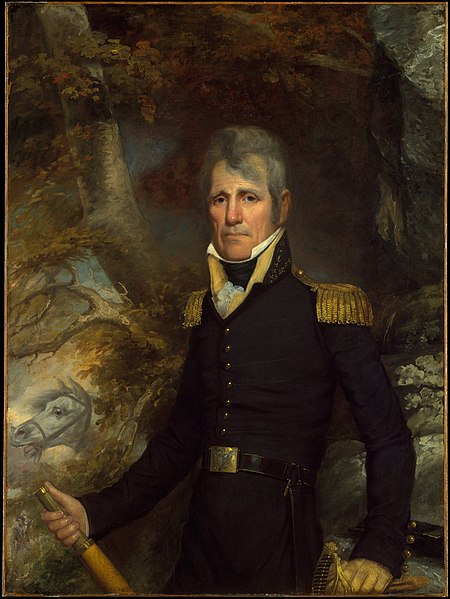
ANDREW JACKSON GETS INVOLVED
Credit: Harris Brisbane Dick Fund, 1964
When word of the massacre reached Nashville, demands for vengeance spread throughout Tennessee. The month before, the federal government had authorized the governors of Tennessee and Georgia to raise troops to fight the Red Sticks, and the Nashville Courier used Fort Mims as a reason to “exterminate the Creek nation.” Soon, four armies took to the field.
Armies and Commanders
Andrew Jackson: West Tennessee // John Cocke:: East Tennessee
John Floyd: Georgia// Ferdinand Claiborne: U.S. Army regulars & militiamen
Allies: Friendly Creeks, Choctaws, and Cherokees
Jackson Marches South
One of Jackson’s closest friends was John Coffee, in command of his cavalry. In October Colonel Coffee’s men rode to Huntsville, in north Alabama. A few days later, Major General Jackson and his militia joined him. They built two supply depots, one of them at the end of the fifty-mile road they cut in six days. Then Jackson continued his march south, determined to destroy every Red Stick village he encountered and cut a highway through their country clear down to Mobile.
For a time, his march stopped on the Coosa River, where he built Fort Strother. Upon learning of a nearby Red Stick town, Tallushatchee, he dispatched Coffee and their Cherokee allies to destroy it. To distinguish themselves from the Red Sticks, the Cherokees wore white feathers and deer tails on their heads. The future hero of the Alamo, Davy Crockett, also participated in this battle.
In the predawn hours of November 3, Coffee’s nine hundred troopers and the Cherokees advanced on Tallushatchee within a mile, and then surrounded it. Detachments of scouts were sent in to draw the Red Sticks out.
The Red Sticks took the bait and charged out of their village, where Coffee’s men caught them in a crossfire. Remembering this fight, Crockett reported that he and others chased forty-six warriors into a house. He wrote: “We shot them like dogs, and then set the house on fire, and burned it up with the forty-six warriors in it.”
Within a mere half hour, 186 Indians were killed, including women and children.
Coffee regretted the deaths of the women and their children, saying in his report that killing them had been an accident due to the warriors fleeing into their homes.
A few days later, Jackson received word from a friendly chief that Weatherford’s 1,000 warriors had surrounded, and was besieging, the village of Talladega some thirty miles from Fort Strother. To slip through Weatherford’s lines, the chief had disguised himself as a hog—put on hogskin, grunted, and walked on his hands and feet in the evening till he made it through the Red Sticks’ camps.
When Jackson learned of this threat to Talladega he, due to his sick and wounded which had depleted his force, first wanted to be reinforced by John Cocke’s men but then decided he couldn’t wait. So, while leaving a token force to guard Fort Strother, Jackson marched to Talladega’s rescue and defeated Weatherford in a decisive victory using Coffee’s tactics. Jackson’s men also captured a Spanish flag at Talladega–evidence of Spain’s alliance with England in supporting the Red Sticks, some seven hundred of whom escaped Jackson’s army. So, the fighting continued.
After this battle, Jackson spent the winter doing battle on a different front: the hunger his troops suffered, many of them now mutinous, and a massacre led by General Cocke’s men that made life ever more difficult for him.
Bibliography
Bunn, Mike and Clay Williams. Battle for the Southern Frontier: The Creek War and the War of 1812. First Printing. Charleston: The History Press, 2008.
Griffith, Benjamin W. Jr. McIntosh and Weatherford, Creek Indian Leaders, Tuscaloosa and London: The University of Alabama Press, 1988.
“Ready.” James looked at his stopwatch then glanced up at Harold and raised his finger. “Get set. Go!”
“Thank you,” Harold said, grinning.
“Ah, now that wasn’t so hard was it., Harold?”
“Nah! It took less than five seconds to say it.”
James put his arm around his friend’s shoulders and steered him toward the snack bar. “Exactly.”
Obviously, James believes saying “thank you” is important. And he’s right! Those two little words carry lots of power. What makes them so powerful?
They express appreciation for whoever we’re thanking and tells them we don’t take them for granted. This feeling of worth is a good motivator for a person to continue doing good deeds for others.
From a business perspective, it can also open doors for wonderful opportunities which may not have opened otherwise. Saying “thank you” is so rare these days, those who say it stand out from the crowd. People remember the “thankers” easier than they do the ungrateful.
Saying “thank you” helps people live happier lives. When we speak these words, we’re focused on others instead of ourselves. Cultivate a habit of gratitude. According to scientific research, those who say “thank you” have better mental and physical health.
So, thank you for reading this short blog. Remember, words of gratitude only takes five seconds.
Like Fort Mims, Fort Sinquefield was a hastily built stockade on an acre of land with just one blockhouse. Unlike Fort Mims, just a few families sought refuge in it when the war broke out. Two of these families – the Ranson Kimbell and Abner James families – left the fort after the Fort Mims massacre in the mistaken (and fatal) belief that the Red Stick threat had ended.
On the afternoon of September 1, a party of Red Sticks attacked Ranson Kimbell’s home where these families had relocated. With the exception of Abner James’s daughter Sarah Merrill and her infant son, all who were present were killed. Other family members avoided death because they weren’t present during the attack. Although Sarah was scalped and left for dead and her son severely injured, she managed to make it back to the fort with him, survived her scalping and her son eventually survived his wounds.
The next day, September 2, some ladies went to a spring about three hundred yards from the stockade to wash clothes when, suddenly, Josiah Francis and one hundred whooping, painted warriors rushed them and the fort. Had it not been for Isaac Hayden’s hunting dogs, all of these ladies might have been killed. When he turned his hounds loose, they sprinted out the fort’s gate and into the attacking Red Sticks, which bought time for them to flee back into the fort. Only one lady was killed in this episode.
With its gate closed, Fort Sinquefield’s residents put up a stout and effective defense. After a two-hour battle, they repulsed the Red Sticks with only one man killed.
Young Jeremiah Austill, who’d soon gain a measure of fame, was sent to General Claiborne’s headquarters at Mount Vernon to deliver a report of the victory.
Bunn, Mike and Clay Williams. Battle for the Southern Frontier: The Creek War and the War of 1812. First Printing. Charleston: The History Press, 2008.
Halbert, Henry S. and Timothy H. Ball. The Creek War of 1813 and 1814. Chicago: Donohue and Henneberry, 1895.
We writers all have little words we tend to overuse. In literary lingo, these are called crutch words. They’re trite, uninteresting, and are usually the first words that come to mind in a rough draft. Although writing them in a rough draft is fine we must, in our revision, try to limit their use. I’ve listed a few here to watch out for, but it is far from exhaustive,







 The Author's Cove: John "Jack" Cunningham on Writing & History