Tips for Writing Effective Dialogue

Well-written, effective dialogue is not real conversation, but it should sound like it.

A Bad Example

“Hey, Jane. How are you doing?” Bob said.

“Pretty good,” Jane said. “And you?”

“Just fine.”

“Are you on your lunch break?”

“Sure. Are you?”

“Yes, I am.”

What’s wrong with my example? Four things.

  • It has zero conflict.
  •  It’s boring (just basic chit-chat).
  • It doesn’t reveal anything about the characters’ personalities and/or interests.
  •  It doesn’t drive the story forward.

A Few Tips

  • Every line of dialogue must have a purpose. If it doesn’t contribute to characterization and advance the plot, delete it and/or revise it till it does.
  • A character’s dialogue must fit his/her personality, education, and emotions. A few examples: (a) If a character is uneducated, give him/her a limited vocabulary. Let the character use simple one and two-syllable words as well as bad grammar. (b) If a character is a narcissist, show it in the way he/she talks. Let that character talk about himself/herself a lot, brag, put down others, etc. In other words, talk and act like a narcissist. (c) If a character is well educated, give him/her a strong vocabulary and let him/her use a few long, multisyllabic words, at least occasionally.
  • Characters don’t always have to respond to another character. Sometimes, silence speaks louder than words.
  • Use contractions. People often use contractions when they talk, so these are a great device to make our characters’ dialogue sound natural.
  • Know your characters. The more we know our characters, their personalities and what motivates them, the easier it becomes to write their dialogue. Even so, writing it effectively is still hard. Getting to know our characters takes time and work. Writing character sketches and their biographies is a great help.
  • Train yourself to listen. Wherever you go, watch people and listen to how they talk. Television and movies are great ways to learn. After all, movie and television scripts are mostly written in dialogue. Spend some time analyzing the actors’ words, how what they say conveys their characters’ emotions and actions.
  • Study other writers’ dialogue. Learn what makes it work, or why it doesn’t work.

Preview in new tab

As one can see, lots of work goes into writing effective dialogue, but the time and effort spent learning is worth it. I hope some of my tips have proved useful in your writing. Till next time!

The Creek War (1813-1814), Part Five: Burnt Corn Creek, The First Battle

Reenactors “fighting” the Battle of Burnt Corn Creek, not far from the site of the actual battle. Photo by author.

In the spring of 1813, the Creeks’ civil war was drawing to a close with the Red Sticks on the verge of winning. Meanwhile, the United States was fighting Great Britain a second time and Britain’s ally, Spain, threatened settlers from West Florida. Though Mobile was now in American hands, the Spanish still held Pensacola as West Florida’s capital. Along the Tensaw, Alabama and Tombigbee Rivers, settlers began building stockades.

The Red Sticks, encouraged by their prophets and the earth’s tremors Tecumseh had prophesied would hit their land,[1] raided the farms of those who opposed them. A party of hostiles under the leadership of Peter McQueen, head warrior of Tallassee, headed for Pensacola, the second such party that went to that town. On the way, when McQueen’s warriors burned plantations owned by métis planters Sam Moniac and James Cornells, word spread like a forest fire—the Red Sticks were going to get ammunition from the Spaniards to fight them!  

Colonel James Caller, commander of the region’s territorial militia, called his men to action. Six companies of riflemen and Captain Dixon Bailey’s thirty métis from the Tensaw, a total of 180 militiamen, marched to find the enemy.

On July 26, they encountered McQueen’s men returning from Pensacola with their packhorses.  At eleven o’clock, during the Creeks’ meal, Caller mounted a surprise attack.

McQueen’s warriors fled across Burnt Corn Creek into a marsh, but then counterattacked while the militiamen plundered what they’d captured. The undisciplined volunteers scattered. Not long after this, they disbanded.

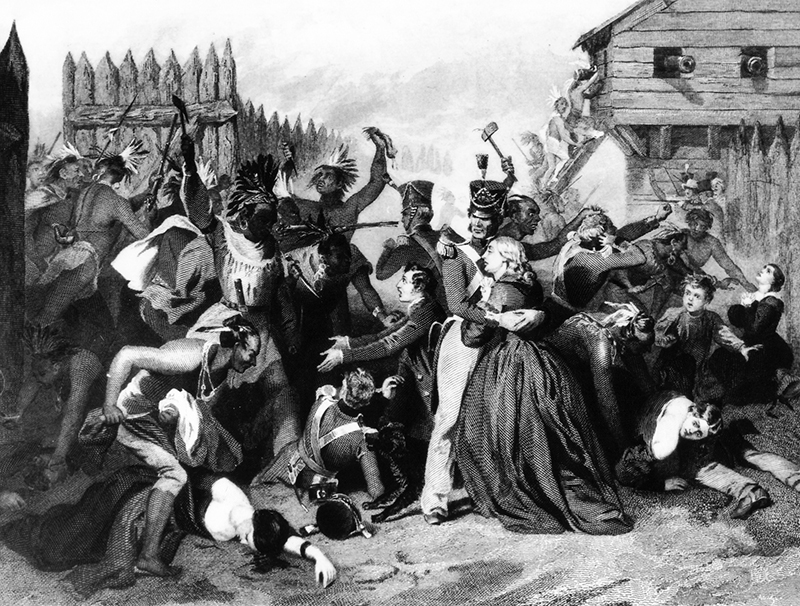
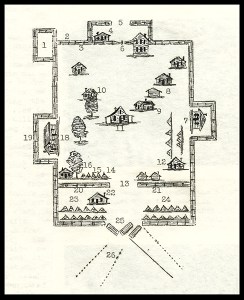
Not many casualties to report in this brief battle but because of Burnt Corn Creek, panicked settlers fled into their stockades. One of these was built on an acre of land around the home of Samuel Mims. His fort, aptly named Fort Mims, would go down in history as one of America’s bloodiest massacres … and the bloodiest one in America’s Old Southwest.

Sources

Bunn, Mike and Clay Williams. Battle for the Southern Frontier: The Creek War and the War of 1812. Fourth Printing. Charleston, SC: The History Press, 2013.

Waselkov, Gregory A. A Conquering Spirit: Fort Mims and the Redstick War of 1813-1814, Tuscaloosa, AL: The University of Alabama Press, 2006


[1] This was the New Madrid earthquake that hit New Madrid, Missouri in December 1811. It was a coincidence, and it frightened settlers and Indians alike. Tecumseh also prophesied about a comet, something he knew would come because British scientists in Canada had told him he and others would see it. It came over Alabama in September of 1811.

KEEP YOUR DISTANCE. NO! GET CLOSE: Some thoughts on Narrative Distance

When beginning writers first learn the rule “show, don’t tell,” many make the mistake of never using the device of “telling.” Both techniques are important and have their purpose, but they aren’t set in granite. Tied into these guidelines is another technique useful in fiction and nonfiction alike, that of narrative distance.

Definition

Narrative distance is how far a writer is from the story. Writers can give readers both a wide view and a closeup view. Riding on a country lane, for example, a person may see farms and crops and barns and animals – that’s the wide view. For a closeup, writers will visit the farm and describe details about it and the farmer.

Fiction and Nonfiction Narrative Distance

Nonfiction

Wide-angle: An overview or synopsis of the topic.

Closeup: Delving into the specifics of the topic.

Fiction

Wide-angle:     Describing a scene or setting in an objective manner.

Closeup:          Showing a character’s emotions, motivations, personalities, etc.

Fiction and Nonfiction

Wide-angle telling is a great way to give readers a break and, although constant telling is boring, constant closeup showing is exhausting. That’s why we writers need to keep our writing balanced between the two.

So, what about your current work in progress? Is it well-balanced?

The Creek War (1813-1814), Part Four: Causes of the Creek War

The causes of Alabama’s Creek War are complex. It started as a civil war between the Lower Creeks, who lived close to the white settlements, many of whom had adopted the white man’s ways, and the Upper Creeks, who lived in a region around and near present-day Montgomery, Alabama and wanted to keep their traditional ways. Inevitably, though, the settlers got drawn into this conflict.

In this blog, I’ll try to keep the reasons as simple and concise as possible.

Westward Movement

After the American Revolution, settlers began moving into Alabama country. Many settled in the Tombigbee-Tensaw River Region just north of Spanish Mobile. These settlements put pressure on the Indians and their way of life. Indians ceded some of their lands to the settlers by treaty, but the settlers wanted more, whereas the Indians depended on the land for survival, such as deer hunting and trading deerskins.

Benjamin Hawkins

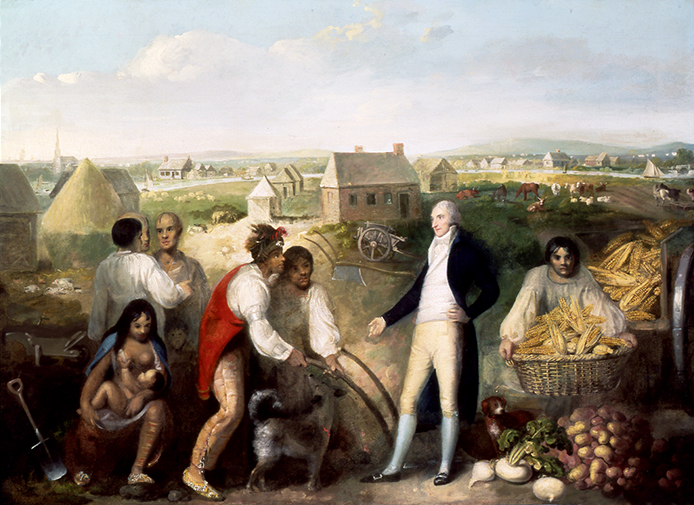
Benjamin Hawkins and the Creek Indians, circa 1805 oil on canvas, 35 7/8 x 49 7/8 inches Greenville County Museum of Art, Greenville S.C.

As the Indian agent to the Creeks during this era, Benjamin Hawkins sought to assimilate them into white culture. Though some did assimilate, others refused. This furthered the division between the tribal bands. 

The Federal Road

In late 1811, the Federal government opened a road through Creek country. It began at Milledgeville, Georgia and was built down to Fort Stoddert, on the Mobile River, with New Orleans its intended destination. Originally, it had been a post road that, in the Treaty of Washington (1805), the government had obtained permission to build. However, it was widened for military purposes in 1811 as another war with Great Britain grew imminent. This road expedited the influx of thousands of settlers into Alabama, increasing the strain between the Creek factions.

Tecumseh

Tecumseh, a Shawnee chief who had familial ties in Alabama, visited the area in 1811 to form a pan-Indian alliance against the settlers. Though he failed to persuade the Choctaws and Chickasaws, he succeeded with many of the Upper Creeks.

At the Upper Creek capital, Tuckabatchee (near present-day Tallassee, Alabama), he gave an impassioned speech, prophesied about an earthquake and a comet and left a prophet there, Seekaboo, to train other prophets.

After he left for home, in Ohio, the earthquake and comet came to pass. This frightened and convinced many to follow their prophets and go to war. The earthquake’s epicenter was New Madrid, Missouri, the largest quake in U.S. history. It was so powerful and huge, Alabama felt its tremors. This earthquake, though, happened by chance. Regarding the comet, British scientists in Canada had told Tecumseh they expected one to pass over.

The warriors who followed the prophets and fought the settlers would become known as the Red Sticks for their red warclubs. Red was the color of war. Twenty-nine towns sided with the Red Sticks. Five towns, under the leadership of William McIntosh and Chief Big Warrior, sided with the settlers.

The War of 1812

While the British impressed sailors off American ships into their Navy and threatened the United States from Canada, Spain, a British ally, threatened settlers in the Old Southwest. Tecumseh allied himself with the British, and the Red Sticks allied themselves with Spain. When some journeyed to Spanish West Florida’s capital, Pensacola, it would be the spark that caused settlers to, at last, get involved in the conflict. But, before the war started, the Red Sticks had already killed a few settlers.

Next Week, War Begins: The Battle of Burnt Corn Creek

Sources

Bunn, Mike and Clay Williams. Battle for the Southern Frontier: The Creek War and the War of 1812. Fourth Printing. Charleston, SC: The History Press, 2013.

McMillan, Malcolm C. The Land Called Alabama, Austin, TX:: Steck-Vaughn Company 1968.

Southerland, Henry DeLeon Jr, and Jerry Elijah Brown. The Federal Road through Georgia, the Creek Nation, and Alabama, 1806-1836. Tuscaloosa and London: The University of Alabama Press, 1989.

The Creek War(1813-1814), Part Three: Leaders of the Settlers

William McIntosh

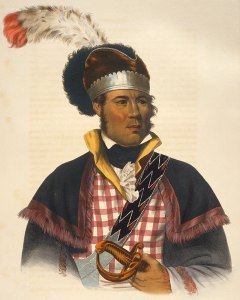
When Captain William McIntosh, a Loyalist, rode into Georgia’s Lower Creek Territory to escape the wrath of Savannah’s Patriots during America’s Revolution, he met and married a prominent Creek woman named Senoya. Senoya, from the tribe’s high-status Wind Clan, gave birth to the younger William McIntosh around 1775. Destined to become a leader in the war against the Red Sticks, young William learned to read and write. Also, he spoke fluent English.

He gained prominence in his own right and formed various alliances with important people such as Indian agents like Benjamin Hawkins and deerskin traders. His influence among his people grew wider and stronger. He owned a plantation, traded in slaves, and kept an inn for weary travelers.

Among his own people, he soon became controversial. He gladly signed treaties with the white man and ceded lands to them. He became chief of Coweta and the leader of the law menders—the Creek police. These warriors enforced the Creek National Council’s laws and carried out sentences. In the past, before the National Council was established, Creek towns executed their own justice on criminals. He would play an important role in the war’s last big battle, at Horseshoe Bend.

In 1825, McIntosh was murdered by his own people, but that is a story for a later post.

Ferdinand L. Claiborne

Ferdinand L. Claiborne, born into a prominent family from Sussex County, Virginia, served as a junior officer under General Anthony Wayne in the Old Northwest Territory (Ohio and Great Lakes region) during the Indian war there. At the Battle of Fallen Timbers (August 20, 1794), he earned a promotion to lieutenant. After the war, he returned east where he became an Army recruiter and in 1802, he resigned from the service with the rank of captain.

His brother, William C.C. Claiborne, was governor of the Mississippi Territory, so he moved to Natchez, the territory’s capital. Here, he became a planter. In 1805, he joined the territorial militia as a major. As a colonel serving under General James Wilkinson, he participated in the first arrest of Aaron Burr, but Burr was released on bond and when he didn’t respond to a summons he was arrested again.

When the Creek War began, Claiborne commanded the territorial militia. Headquartered at Fort Stoddert on the Mobile River in 1813, he commanded this region when Weatherford’s Red Sticks attacked nearby Fort Mims. He also led the war’s first offensive, an invasion of the Upper Creek Nation, defeating the Red Sticks at the Battle of the Holy Ground in present-day Lowndes County, Alabama.

His poor health forced him to return to Natchez, where he died in 1815. I couldn’t find any picture of him.

Pushmataha

In the early 1800s the Choctaw nation consisted of three geographical districts. To the northeast: the Ahepyt, or Potato Eaters District. To the west: Okla Falaya, or Long People District. And in the nation’s southern region: Okla Hannali, or Six Towns District. Within each of these districts were Choctaw towns and villages, most of them in present-day Mississippi.

Pushmataha, greatest of all Choctaw chiefs, led the Six Towns. Although not much is known about his ancestry and childhood, historians generally agree that he was born in 1764 in what is now Macon, Mississippi. He gained a reputation as a brave warrior and great fighter against other tribes, which led to him becoming the principal chief of Six Towns in 1800. However, he never fought the white man.

When the Shawnee leader Tecumseh visited the Mississippi Territory in 1811 to form an alliance with the Old Northwest’s tribes against the white settlers, he tried to get the Choctaws to join it. Although Tecumseh was a great orator, he met his match with Pushmataha’s eloquence and persuasiveness. The chieftain followed Tecumseh to different Choctaw towns and spoke against him at council meetings. In the end, the Choctaws made Tecumseh leave their nation. Tecumseh then went to the Creeks, many of whom listened to his words.

With the American military rank of lieutenant colonel, and later brigadier general, Pushmataha fought in twenty-four battles, some of them under Andrew Jackson. He died in 1824 and is one of only two Native Americans buried in Washington, D.C.’s Congressional Cemetery.

Andrew Jackson

Andrew Jackson led the Tennessee militia during the Creek War and broke the back of Red Stick power at the famous Battle of Horseshoe Bend. This victory vaulted him to national prominence and eventually, the White House. Also participating in this battle were two future heroes of the Texas Revolution, Sam Houston and David Crockett.

At Fort Jackson, in present-day Wetumpka, Alabama, he received the surrender of the Red Stick leaders, including William Weatherford.

A Devotional: Be Careful Whom You Follow

Photo by Matt Weissinger on Pexels.com

My brother-in-law’s white pickup roared ahead, leading me toward his cotton farm on a warm summer day. Though I’d never driven there before, following him was easy, that is, until we reached the traffic light on the edge of town.

Seconds after he passed beneath its green light, it flicked to red. I braked and waited, and assured myself that I’d catch up. But by the time it changed to green, he’d sped well out of sight. I clenched my steering wheel tighter. Narrow country road stretched for miles ahead. There were no trucks, no cars–nothing. I had no idea where I was. “Great. Now what am I going to do?” I muttered.

I suddenly breathed easier–I saw it– a distant white pickup racing past trees and cotton fields. I accelerated; the truck accelerated. I gained more speed; so did the truck. I fumed. Why is he going so fast? I can’t afford a speeding ticket. We’re only going to a picnic.

At an intersection, the pickup made a sharp left turn. My thoughts froze and my spirits sagged. I’d never been here before, not even with my sister. My gas gauge’s needle was approaching empty. I slowed., noticed a nice neighborhood on my left, and turned down a street where I parked.

Slumped against my steering wheel, I berated myself. I’d followed the wrong white pickup. The only thing I could figure was that while I waited at the red light, that white truck had turned in front of me from a side road. And while it looked like my brother-in-law’s vehicle, it wasn’t. I’d failed to keep close to him.

I called my sister on my cell phone. “Lynn, I have no idea what happened.”

“Where are you?” she said, her voice frantic. “We’re all waiting for you.”

“I’m fine. I just have no idea where I am.” I gave her the name of the street I’d turned onto and a brief description of what had happened.

“I’ll send Myles to get you.”

“Thanks.” Sighing, I clicked off my phone.

Minutes later, my nephew Myles arrived in his truck and led me in the right direction. While I followed him, my thoughts wandered back to Paul’s warning about false teachers and how that wrong white truck reminded me of them. Paul called them “false apostles, deceitful workers, masquerading as apostles of Christ” (2 Corinthians 11:13). On the outside, they look and sound like true Christians, but they preach another Jesus, a different gospel from the true one, and lead others astray.

I’d better be more careful, I thought, as I turned onto my brother-in-law’s property. As I got out of my car, I determined to walk even closer with my Savior, to be more diligent in prayer, Bible study, and obedience. I didn’t want a false teacher leading me astray as that white pickup had.

Originally published in Live: A Weekly Journal of Practical Christian Living, June 4, 2017, Gospel Publishing House, Springfield, Missouri.

Copyright 2017 Jack Cunningham

The Creek War(1813-1814), Part Two: Leaders, The Red Sticks

Let’s take a brief look at six major figures involved in the Creek War: Chief William Weatherford, Chief Menawa, Chief William McIntosh, Generals Ferdinand Claiborne and Andrew Jackson and Chief Pushmataha.

In this post, we’ll look at two Red Stick leaders. Red Sticks were those Creeks who opposed the settlers, so-called for their red warclubs, a deadly weapon. Red was the color of war in Creek society.

Red Sticks

William Weatherford

In 1780 Charles Weatherford, a Scotsman and Loyalist to Britain, rode into Alabama with his friend Samuel Mims to escape the violence and bloodshed of America’s revolution against Great Britain. Eventually, Sam Mims headed south, toward the Tensaw River and Spanish Mobile while Charles continued west to the Creek town of Coosada on the Alabama River, not far from present-day Wetumpka and Montgomery, Alabama. Here, in either 1780 or 1781, he married Sehoy, a wealthy Creek woman of the Wind clan. In 1781, Sehoy gave birth to a son who would become a legend—William Weatherford.

Nine clans (families) comprised Creek society, with the most powerful and privileged clan being Sehoy’s. Charles established a plantation, was a slave owner and slave trader, and also traded in cattle and deerskins. William Weatherford inherited this wealth.

As he grew to adulthood, Weatherford gained a reputation as a good leader as well as an excellent athlete. He was friendly to all who visited him, white men and Indian. In fact, though raised as a Creek, he dressed like a white man and adopted many of the white man’s ways.

Before the war, he advised his people to stay neutral because he knew the Creeks couldn’t win. Most of his relatives sided with the settlers, so why did he choose the Red Sticks’ side? His descendants say he joined to limit violence and save lives. Others say he was devoted to the cause. Two conflicting stories have tried to explain his decision.

Story Number One

Weatherford was returning home with his brother-in-law Sam Moniac after trading cattle when he found his wife and children being held by the Red Sticks. Their leaders, the prophet Josiah Francis and Chief Peter McQueen, told them they’d kill them in front of their families if they didn’t join their cause.

Moniac seized Francis’s warclub and whacked him on the head, stunning him long enough to gallop away. Weatherford, after warning them their fight was lost before it began, joined them because, as he was reputed to have said, “you are my people.”

Story Number Two

He returned from Pensacola and found that his family had been taken to a Red Stick village, so he went there with the intent of sneaking them out if an opportunity arose. That opportunity never came, the war’s first battle was fought and everyone assumed he’d become their leader. Thus, he joined them because he saw no other way out.

A Little-Known Fact

Gregory Waselkov, in his recent work A Conquering Spirit, writes that when Weatherford and Moniac drove their cattle to a Choctaw town, Weatherford held a “secret interview” with the town’s leader and tried to persuade him to fight in the coming war, but the Choctaw refused. Waselkov, then, is one historian who believes Weatherford was totally devoted to the Red Sticks’ cause.

Creek House, Fort Toulouse State Park, Wetumpka, Alabama Photo by Author

Whatever the truth, Weatherford would play a major role in the Creek War’s early battles and would lead one of the bloodiest massacres in American history, at a stockade built around Sam Mims’s house on the Tensaw.

Because of Fort Mims, Weatherford’s life was in constant danger from settlers who’d lost loved ones there. Till the day he died in 1824, he suffered from nightmares about the event but thanks to his family’s prominence, he was able to stay in Alabama and prosper as a plantation owner in Baldwin County, thus avoiding the infamous Trail of Tears.


Chief Menawa

Circa 1765, Menawa was born to a Creek woman and a Scottish father in the Creek town of Okfuskee. The name given him in his youth was Hothlepoya, “Crazy War Hunter,” for his raids and exploits in Tennessee where he stole American horses. These exploits made him famous.

In 1811, he became the second chief of Okfuskee. He acquired wealth through trade, cattle and hog raising, and trading horses. During the Creek War, he lost his wealth but his political prominence and influence within the tribe continued. He died in 1836 on the Trail of Tears.

Sources

Griffith, Benjamin W. Jr. McIntosh and Weatherford, Creek Indian Leaders, Tuscaloosa and London: The University of Alabama Press, 1988.

Halbert, Henry S. and Timothy H. Ball. The Creek War of 1813 and 1814. 1895. Reprint edited by Frank L. Owsley Jr. Tuscaloosa: University of Alabama Press, 1995.

Waselkov, Gregory A. A Conquering Spirit: Fort Mims and the Redstick War of 1813-1814. Tuscaloosa: University of Alabama Press, 2006.

Links

“Menawa,’ American Battlefield Trust, https://www.battlefields.org/learn/biographies/menawa

Kathryn Braund,“Menawa,“ Encyclopedia of Alabama, updated May 16, 2019, http://encyclopediaofalabama.org/article/h-3594

Quick Tip: Use the Right Word

When we ponder definitions of words, we most often think about their denotative meaning–how the dictionary defines them.

However, words also have connotative (implied) definitions. For example, blue is, by strict definition a color. But if we say “Julie is blue,” we don’t literally mean she’s that color. Rather, we’re implying that she’s sad, maybe even depressed. We’d understand its meaning by its context.

Choose words that fit the story’s context, both connotative and denotative. By using the right words in the right context, by being precise., we can help readers visualize what we’ve written.

Minimalist versus Maximalist Prose

In today’s literary landscape, two writing styles dominate—minimalist and maximalist. What are they?

Minimalism

Minimalist writing is simple and direct with a tight focus on the literary subject. For the most part, it’s devoid of imagery such as similes, metaphors, and personification. Also, minimalist writing doesn’t use backstories. The idea behind such writing is to give readers just enough information to let their imaginations run wild. Minimalists look to write their prose as tightly as possible.

One of the most famous minimalist stories is Ernest Hemingway’s The Old Man and the Sea. I read it in the sixth grade. It was easy to follow because of the language’s simplicity. No metaphors, no similes, just sparsely written prose.

Maximalist Writing

Maximalist writers use lots of fancy language that’s full of imagery, backstory, long descriptive passages, lengthy sections of dialogue, and long, complex sentences. They add detail after detail to enlarge their stories.

Interior designers use maximalism to tastefully decorate a home or room in excess. In literature, maximalist authors tastefully write prose in excess. For an example of maximalist prose, read William Faulkner’s book, Absalom, Absalom!

So, which style is right? Either one. It depends on which one an author’s most comfortable with.

How about you. Are you a minimalist or a maximalist?

Use a Juxtaposition

“It was the best of times, it was the worst of times, it was the age of wisdom, it was the age of foolishness, it was the epoch of belief, it was the epoch of incredulity, it was the season of Light, it was the season of Darkness, it was the spring of hope, it was the winter of despair, we had everything before us, we had nothing before us…” Charles Dickens, A Tale of Two Cities.

In this famous opening line to Dickens’s classic, we find that he used a literary device called juxtaposition. For example: best of time/worst of times, wisdom/foolishness, belief/incredulity, etc.

Juxtaposition uses opposites, or near opposites, to create special effects and evoke emotions in readers. We find this technique not just in writing, but in other art forms as well.  In writing, this technique can be used in both fiction and nonfiction, and poets use it a lot too.

How to Use Juxtaposition in Literature

Use it in sentences, such as Dickens used in the above example.

Use it with characters. For example, let one character be a constant worrier during a time of crisis and juxtapose him with a character who’s calm during this same crisis. In Mark Twain’s classic, The Prince and the Pauper, two lifestyles are contrasted—poor Tom Canty’s and wealthy Prince Edward’s. When we make our characters unique, it makes it easier to juxtapose them in different settings and situations.

Use it in settings. For maximum effect, don’t make the setting predictable. If Tom is in love with Carol and plans to propose to her, put them in an unpredictable place where he does this. Perhaps they’re attending a professional boxing match, and he proposes to Carol there. Fighting contrasted with romance. The boxing could be a metaphor, or foreshadowing, of future conflict in their marriage.

Using juxtapositions must be intentional, so they require some thought, but if used well, they’ll enhance your writing.