How the Catholic Church Came into Existence, Part 1

Was the Apostle Peter the First Pope?

According to Roman Catholics, based upon Matthew 16:18, the Apostle Peter was the first pope. But was he? Let’s examine this a little closer.

First, what does the word “pope” mean? It comes from the Latin word papas. However, the term wasn’t used until the 3rd century.

Matthew 16:13-20

In this passage, Jesus asks His disciples what people are saying about Him. Their answers? Elijah, Jeremiah, John the Baptist, etc. Then Jesus turns to them and says, But who do you say that I am?”

Peter answers: “You are the Christ, the Son of the Living God.”

Jesus responds: “… And I tell you, you are Peter, and on this rock I will build my church and the gates of hell shall not prevail against it.”

Jesus plays upon two words in the Greek. Peter’s name, petros (pebble, or stone), and “rock,” petra. What is the big rock (petra) Jesus is talking about? Three possibilities.

  1. Peter’s confession that Jesus is the Christ (the Anointed One)
  2. Christ’s teachings
  3. Peter himself

Why “Rock ” Does Not Refer to Peter

  1. Although he was a spokesman for the apostles, we have no record that he exercised authority over them.
  2. Paul once rebuked Peter in public (Galatians 2:11-14). Certainly, then, Paul didn’t recognize Peter’s papal authority.
  3. Peter was a leader in the Jerusalem church, but other churches had leaders as well.
  4. At the Council of Jerusalem, Peter submitted to James’s decision regarding Gentiles in the church and circumcision (Acts 15:7-21).
  5. The apostles in Jerusalem sent Peter into Samaria (Acts 8:14) to preach the Gospel. If he had ultimate authority over the church, he would have done the sending out.
  6. No Biblical record exists of Peter ever going to Rome.  We’ll examine this in the next post, due out after Christmas.

Who Founded the Church in Rome?

Short Answer: No one knows for sure. Although Peter played a role in founding the Jerusalem church, James, the brother of Jesus, served as its leader. According to the book of Acts, Peter ministered to the Jews in Palestine.

What about Paul? No, he didn’t establish the Roman church either. In Acts 18:2, we read that he met a Jewish couple, Aquila and Priscilla, who were believers. Along with other Jews, they’d been kicked out of Rome by the Emperor Claudius in 49 A.D. At this point in history, Christianity was still considered a Jewish sect. Thus, a Roman church probably existed before Paul visited it.

The Church’s Foundation

The church is built upon the apostles’ and prophets’ foundation: their teachings and doctrine, with Jesus Christ Himself as the cornerstone. The cornerstone binds all the other stones in a building. Without it, the building can’t stand straight and true. It’s the most important stone, as it’s where a stone building’s construction starts.

When we want a sure spiritual foundation, we must build it upon Christ, not Peter. Peter himself wrote that Christ is the church’s foundation: 1 Peter 2:6-8.

Bibliography

Cairns, Earle E. Christianity Through the Centuries. Revised Edition. Grand Rapids, Michigan: Zondervan Publishing House, 1967

Hinson, E. Glenn, The Early Church: Origins to the Dawn of the Middle Ages. Nashville, TN: Abingdon Press, 1996.

Engelbrecht, Edward A., and Laura L. Lane, eds. The Church from Age to Age: A History from Galilee to Global Christianity. St. Louis: Concordia Publishing House, 2011.

Wilkins, Michael J. “Matthew.” In ESV Study Bible, edited by Lane T. Dennis and Wayne Grudem, page 1999. Wheaton, IL: Crossway, 2008.


September Book Release: Frontier Circuit, A Story of the Creek War

A murderous gang and a band of fanatical Creek Indians threaten the lives and work of two circuit riders. When war breaks out the preachers and settlers flee into a stockade called Fort Mims. A girl named Annabelle falls in love with one of the preachers, but will they survive the Creeks’ massacre of the stockade’s inhabitants to see their destinies fulfilled? Due for release September 26. Stay tuned for updates.

The Creek War(1813-1814), Part One: Background to Conflict

Today, I begin a series on the Creek War (1813-1814). Most of this war was fought in Alabama when it was still part of the Mississippi Territory, and it was part of the much larger War of 1812, as Britain and Spain were allies of the Red Stick Creeks. I’ll also share some videos along the way that will go into more detail on the subjects covered. I’ll continue sharing writing tips in other blogs, but this series ties into my novel coming out, hopefully, next year. Its working title is Circuit Riders: A Story of the Creek War.

The Geographical Setting and Settlements

Before we discuss the Creek War, it’s helpful to briefly establish some background to this conflict.

During and immediately after the American Revolution, many settlers who sided with the British (Tories) left their homes in the former colonies and migrated to Alabama, settling in the Tensaw-Tombigbee valleys just north of Mobile. Many married Indian women and became rich through trade and other means. Their offspring were called métis, French for mixed blood. Originally, France ruled Mobile, but the British took over after the French and Indian War.

In 1780 Spain, an American ally during the Revolution, captured Mobile. Some Spaniards then moved up the Tombigbee River and built a fort on a limestone bluff overlooking the river that would later become Fort St. Stephens.

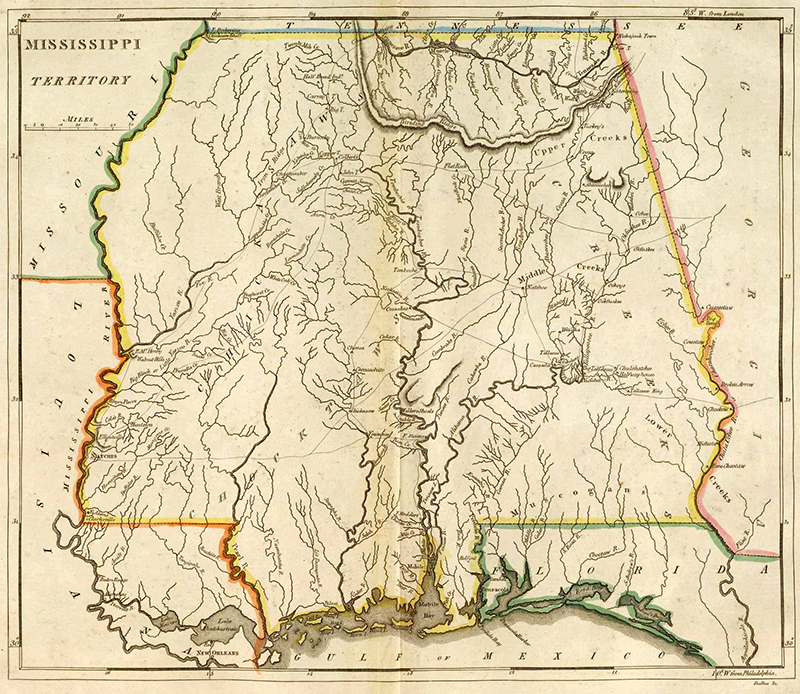
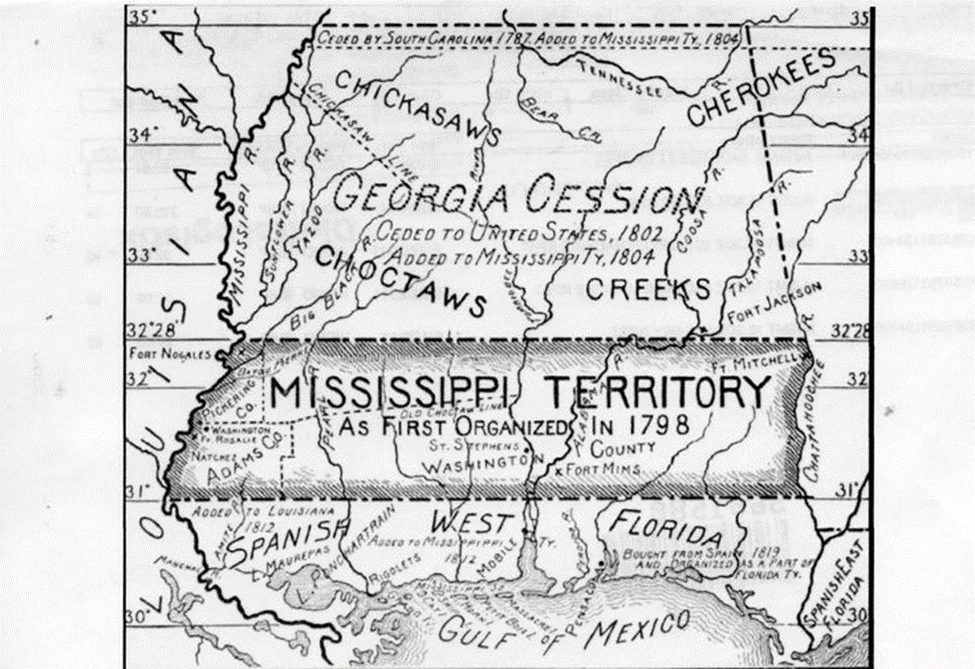
Under the Treaty of Paris (1783) at the end of the Revolution, Spain was granted all of Louisiana as well as territory along the Gulf of Mexico, called East and West Florida. In 1798, Congress established the 31st parallel as the boundary between Spain and the United States and created the Mississippi Territory. It later expanded to the 32nd parallel (1802) when Georgia ceded lands to the federal government. The map below shows what the Territory, a vast region spreading from the Chattahoochee River to the Mississippi River, looked like in 1813, at the time of the Creek War.

In 1799, the federal government built Fort Stoddert on the Mobile River, and in April 1813 the American general, James Wilkinson, captured Mobile without a shot fired.

American pioneers who weren’t Tories, along with their slaves and cattle, began moving into Alabama and Mississippi country in the early 1800s.

The Tribes

Four tribes lived in the Mississippi Territory during this era: the Choctaws, the Chickasaws, the Cherokees, and the Creeks. With the exception of the Pueblos in present-day New Mexico, these tribes were more culturally advanced than all the other tribes north of Mexico.

The Creeks were a matrilineal society, which meant a child’s inheritance was passed through the mother. Women managed households and farmed. Men hunted and fought wars. Often, chiefs and headmen consulted their women when decisions had to be made on issues that concerned their towns. However, when it came to war, chiefs made the decisions.

Because their society was matrilineal, a white man who’d married a Creek woman was considered Creek. Two of the Creek War’s most prominent Creek leaders were cousins who fought on opposite sides, William Weatherford and William McIntosh, but we’ll get into that later.

The Choctaws, Chickasaws, and Cherokees were also matrilineal. Most of the members of these tribes supported the settlers. One Choctaw leader we’ll be discussing later is Pushmataha, a highly respected chief.

Next week we’ll look at two major leaders of the Red Sticks.


Sources


McMillan, Malcolm C. The Land Called Alabama, Austin, TX:: Steck-Vaughn Company 1968.

Waselkov, Gregory A. A Conquering Spirit: Fort Mims and the Redstick War of 1813-1814, Tuscaloosa, AL: The University of Alabama Press, 2006


Frontier Circuit

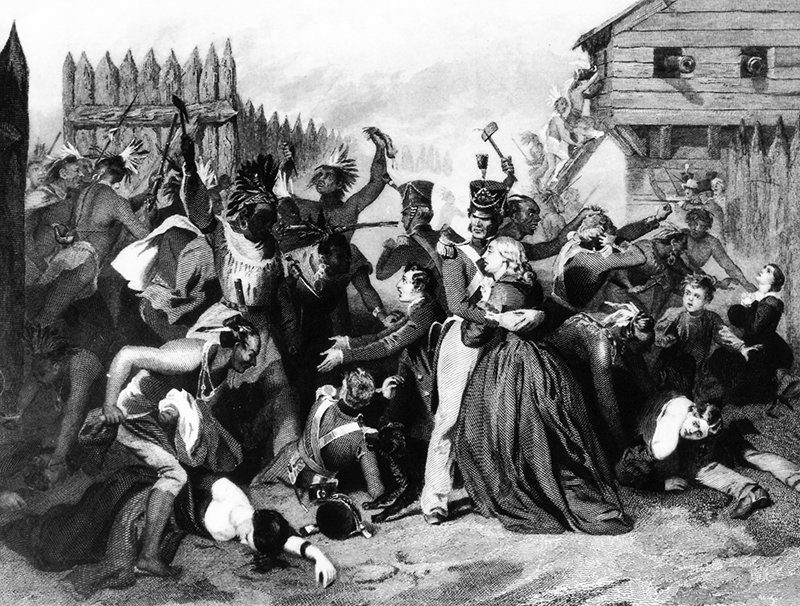
Ever since the fourth grade, when I first saw this picture in a textbook, it captured my imagination. It’s a romanticized (and inaccurate) depiction of the Fort Mims massacre that took place early in the Creek War (1813-1814) in lower Alabama. I was too young at the time to care about the inaccuracies, but throughout my life this image has stayed with me. Once I became a professional writer, I yearned to write a novel about this tragic event. What kept me from doing it after forty years of literary effort? I wasn’t sure how to begin it.

Well, coming this fall, the book will finally be released by Ashland Park Books: Frontier Circuit, A Story of the Creek War.

Meanwhile, I am currently revising a novel set in a more modern era, the 1940s and 50s.

Lieutenant Spruce McKay Osborne (1784-1813)

Lieutenant Spruce McKay Osborne was born in Rowan County, North Carolina in 1784. Upon his graduation from college there, he moved to the Mississippi Territory to practice medicine. When the Creek War broke out in 1813, he joined the Mississippi Volunteers as its surgeon and served at Fort Mims.

He didn’t think he’d see any action there, so he wrote General Claiborne, commander of the territorial militia, a request for a transfer to a more active region. Six days later, Redstick Creeks attacked the fort and massacred its inhabitants. Lieutenant Osborne was killed near the end of the battle. His portrait is the only picture we have of any of the fort’s inhabitants. Hundreds were slaughtered. Although we know the names of some who perished, we do not know the names of everyone.

The lieutenant is buried in a mass grave with others who perished.

Sources

https://www.findagrave.com/memorial/9508351/spruce_mckay-osborne

Waselkov, Gregory A. A Conquering SpiritL Fort Mims and the Redstick War of 1813-1814. Tuscaloosa, AL.: The University of Alabama Press, 2006.

Called to be a Writer?


WritingThroughout my thirty-plus years of writing professionally, people have sometimes told me they want to become a writer. Well, that’s great.

Once I start explaining everything that’s involved in pursuing the craft, though, most of them, but not all, back away.

On some occasions when people tell me this, I just nod and smile unless they ask for advice. Why? Because I’m waiting to see how serious they are, to see whether or not God has truly called them.

Let’s face it. Writing isn’t for the faint-hearted. Like any ministry, if a person isn’t called to write, then I don’t recommend doing it. I wouldn’t recommend myself to join a choir, either, since I sing like a coyote with a sore throat.  

How does someone know whether or not God has called him/her into the literary world? Here are a few things to consider.

1. Psalm 37:4 “Delight thyself also in the LORD; and he shall give thee the desires of thine heart.”

This verse doesn’t mean we can desire anything and the Lord will give it. It means that if we delight in Him and put Him first in our lives, He’ll put His desires in us. If we follow this pattern, He’ll give us a desire to become a writer. This desire will develop into a passion which will become so strong that we’ll refuse to quit no matter who or what tries to hinder us.

2. John 10:10 “The thief cometh not, but for to steal, and to kill, and to destroy: I am come that they might have life, and that they might have it more abundantly.”

Our Lord and Savior has called us to an abundant life, one that overflows with joy and fulfillment. If we’re called, we’ll feel that joy while we write. If we miss a writing day, we’ll feel let down. In my case, I am sometimes miserable.

3. I Samuel 17:36 “Thy servant slew both the lion and the bear: and this uncircumcised Philistine shall be as one of them, seeing he hath defied the armies of the living God.”

Before David accepted Goliath’s challenge, God had prepared him by teaching him to fight lions and bears. Likewise, God prepares us for whatever He’s called us to do. Just as He enabled David to kill Goliath, so He’ll enable called writers to succeed. Not fame and fortune, necessarily. Few writers have this. But they will reach the skill level where they can sell their work. It may not happen overnight, and usually doesn’t, but through hard work (preparation) and a little bit of  God-given talent the bylines will come.

Has God called you to be a writer? Don’t ever give up your dream. He will always bless it. 


Books

Active Voice versus Passive Voice

In this post, we’ll learn a few ways to use the passive voice in our prose.

In fiction writing, an active voice sentence is usually preferable to the passive because the active voice is stronger.

Active Voice

The kitten (subject=doer of the action) scooted (active voice) up the tree (tree = object, the receiver of the action).

Passive Voice

The girl (receiver of the action) was hit (passive voice) by a tennis ball (subject=doer of the action).

How to Identify the Passive Voice

  1.  The object of the action sits in the spot where the sentence’s subject normally goes.
  2. A linking verb joins the past tense of an action verb.

When to Write in the Passive Voice

Some writers believe we should always write in the active voice. However, cases do exist where the passive works better. Here are a few examples of that.

1. TO WITHHOLD INFORMATION FROM THE READER OR THE DOER IS UNKNOWN.

John was insulted in class.

The diamonds were stolen yesterday.

2. TO ADD VARIETY TO OUR PROSE.

Manuscripts whose sentences are all active move quickly and make for a fast read. This is particularly good to use in thrillers.

3. TO EMPHASIZE THE DIRECT OBJECT (THE RECEIVER) OF THE ACTION.

The puppy was bitten by the cat. (The puppy is emphasized.)

John was defeated by his younger brother in a track meet. (John is emphasized.)

Don’t discard the passive voice, but don’t overdo its use either. Instead, use it judiciously. About ninety percent of our writing should be active. However, as we saw in the above-mentioned examples, the passive voice does have a place in our prose.

Traits of a Good Beta Reader

Over thirty years ago, when I first started my writing career, my literary passion drove me to learn everything I could about the craft as fast as possible. One of the many ways I learned was through beta readers. Even though I now have numerous bylines to my credit, and several books I’ve either written or contributed to, I still use them.  All writers do, including those who write bestsellers.

What is A Beta Reader?

A beta reader is someone who reads our manuscripts with an objective, yet critical eye. This person looks for such things as holes in our story’s plot, awkward phrasing, narrative inconsistencies, storylines that aren’t believable, poor characterization and dialogue, and similar things. 

Beta readers are critical to our writing careers.  We get so caught up in our writing that we can’t see our words objectively, whereas a good beta reader can. If we follow a good beta reader’s advice, our finished product will be more polished which, of course, increases our chances of finding publishing success.

My One Big Rule for Beta Readers

Notice that I said good beta reader. Not all beta readers are the same.  From my earliest writing days, I’ve followed one rule: “If all a beta reader does is give me a pat on the back and say my work is good, I never let that person read another manuscript. If a beta reader gives little or no constructive input—again, I don’t let them read another manuscript.”

I’ve always been strict about this. Pats on the back without useful input does not help us writers improve. No matter how advanced we are in this craft, we always have room to get better.

Fortunately, as time has passed on, I’ve developed friendships with good beta readers. Unlike my early years, I no longer need to “test-drive” them or seek them out. Nowadays I rarely have to implement my rule. 

Photo by Ron Lach on Pexels.com

Five Traits of a Good Beta Reader

Honest Feedback. Good beta readers aren’t afraid to tell writers what they honestly think about their manuscripts. If they don’t like it, they’ll not only say they don’t, but they’ll also say why. They’ll word their opinion in such a way that it doesn’t kill a writer’s dream. Not only will they point out a manuscript’s weaknesses, they will also applaud its strengths. In other words, they offer a balanced opinion.

Encouragers. They share a writer’s literary dream and want him/her to succeed. They will encourage, motivate, and congratulate authors when they get published. For me, my greatest joy comes when I see someone, whose work I have read and critiqued, get published. I appreciate that person’s sacrifice and hard work to achieve their goal.

Knowledgeable. Most good beta readers are serious writers either knowledgeable about the craft or are in the process of learning it through hard study.

Readers. I’ve also benefited from serious readers, particularly those in my target audience.  A serious reader, by my definition, is someone who reads lots of books critically. They understand why they like certain books and why they don’t, and they can give solid reasons for their opinions. I once heard a librarian call into a radio talk show to comment on a certain bestselling book. A few days earlier, I’d scanned some pages of this same book at a store. The librarian and I shared the same opinion—bestseller or not, the author’s writing was amateurish. This librarian would make a great beta reader.

Understands Our Genre. Under the broad categories of non-fiction and fiction are different genres. Each genre has its own set of rules and characteristics. Beta readers who aren’t familiar with our chosen genre may unintentionally offer bad advice. My genres are historical fiction, short stories, and certain genres of magazine articles. If someone asked me to critique a science fiction manuscript, I’d be able to offer basic advice on writing style and technique, but that’s all I could do. I haven’t read much in that genre, thus I have little knowledge about the rules connected with it

    Three Beta Readers to Avoid

    Family. Family members are usually reluctant to give us honest input for fear of hurting our feelings or ruining a relationship. If we happen to have someone in our family who meets the five criteria I listed above, though, it is fine to use them. However, such family members are rare.

    Friends Who Aren’t Writers. More than likely, these friends won’t meet the above-listed criteria, either.

    Token Critiquers. Token critiquers read a manuscript, or maybe just scan it, and then make only a comment or two per page or per manuscript. Writers need in-depth critiques, not the token variety.

      A Final Word

      If we can find more than one good beta reader, then our finished manuscript will be that much better. If two or more beta readers make the same comment about our work, this is a sure sign that we’d better heed what they tell us and revise accordingly.

      Finally, always thank your beta readers. They made some sacrifices of their own time to help you, and a little gratitude goes a long way.