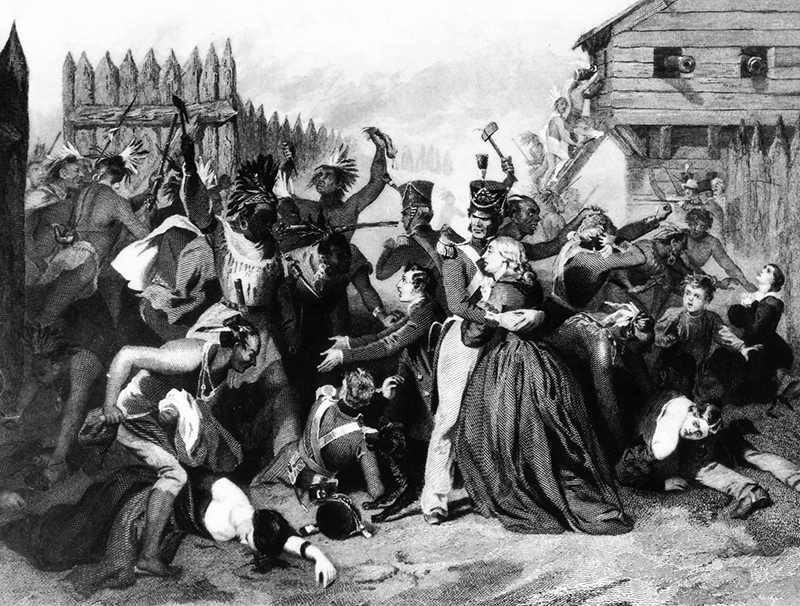
Ever since the fourth grade, when I first saw this picture in a textbook, it captured my imagination. It’s a romanticized (and inaccurate) depiction of the Fort Mims massacre that took place early in the Creek War (1813-1814) in lower Alabama. I was too young at the time to care about the inaccuracies, but throughout my life this image has stayed with me. Once I became a professional writer, I yearned to write a novel about this tragic event. What kept me from doing it after forty years of literary effort? I wasn’t sure how to begin it.
Well, coming this fall, the book will finally be released by Ashland Park Books: Frontier Circuit, A Story of the Creek War.
Meanwhile, I am currently revising a novel set in a more modern era, the 1940s and 50s.
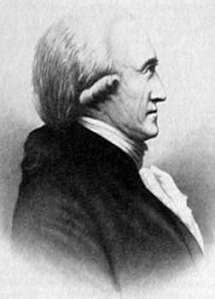
Lieutenant Spruce McKay Osborne was born in Rowan County, North Carolina in 1784. Upon his graduation from college there, he moved to the Mississippi Territory to practice medicine. When the Creek War broke out in 1813, he joined the Mississippi Volunteers as its surgeon and served at Fort Mims.
He didn’t think he’d see any action there, so he wrote General Claiborne, commander of the territorial militia, a request for a transfer to a more active region. Six days later, Redstick Creeks attacked the fort and massacred its inhabitants. Lieutenant Osborne was killed near the end of the battle. His portrait is the only picture we have of any of the fort’s inhabitants. Hundreds were slaughtered. Although we know the names of some who perished, we do not know the names of everyone.
The lieutenant is buried in a mass grave with others who perished.
Throughout my thirty-plus years of writing professionally, people have sometimes told me they want to become a writer. Well, that’s great.
Once I start explaining everything that’s involved in pursuing the craft, though, most of them, but not all, back away.
On some occasions when people tell me this, I just nod and smile unless they ask for advice. Why? Because I’m waiting to see how serious they are, to see whether or not God has truly called them.
Let’s face it. Writing isn’t for the faint-hearted. Like any ministry, if a person isn’t called to write, then I don’t recommend doing it. I wouldn’t recommend myself to join a choir, either, since I sing like a coyote with a sore throat.
How does someone know whether or not God has called him/her into the literary world? Here are a few things to consider.
1. Psalm 37:4 “Delight thyself also in the LORD; and he shall give thee the desires of thine heart.”
This verse doesn’t mean we can desire anything and the Lord will give it. It means that if we delight in Him and put Him first in our lives, He’ll put His desires in us. If we follow this pattern, He’ll give us a desire to become a writer. This desire will develop into a passion which will become so strong that we’ll refuse to quit no matter who or what tries to hinder us.
2. John 10:10 “The thief cometh not, but for to steal, and to kill, and to destroy: I am come that they might have life, and that they might have it more abundantly.”
Our Lord and Savior has called us to an abundant life, one that overflows with joy and fulfillment. If we’re called, we’ll feel that joy while we write. If we miss a writing day, we’ll feel let down. In my case, I am sometimes miserable.
3. I Samuel 17:36 “Thy servant slew both the lion and the bear: and this uncircumcised Philistine shall be as one of them, seeing he hath defied the armies of the living God.”
Before David accepted Goliath’s challenge, God had prepared him by teaching him to fight lions and bears. Likewise, God prepares us for whatever He’s called us to do. Just as He enabled David to kill Goliath, so He’ll enable called writers to succeed. Not fame and fortune, necessarily. Few writers have this. But they will reach the skill level where they can sell their work. It may not happen overnight, and usually doesn’t, but through hard work (preparation) and a little bit of God-given talent the bylines will come.
Has God called you to be a writer? Don’t ever give up your dream. He will always bless it.
In this post, we’ll learn a few ways to use the passive voice in our prose.
In fiction writing, an active voice sentence is usually preferable to the passive because the active voice is stronger.
Active Voice
The kitten (subject=doer of the action) scooted (active voice) up the tree (tree = object, the receiver of the action).
Passive Voice
The girl (receiver of the action) was hit (passive voice) by a tennis ball (subject=doer of the action).
How to Identify the Passive Voice
The object of the action sits in the spot where the sentence’s subject normally goes.
A linking verb joins the past tense of an action verb.
When to Write in the Passive Voice
Some writers believe we should always write in the active voice. However, cases do exist where the passive works better. Here are a few examples of that.
1. TO WITHHOLD INFORMATION FROM THE READER OR THE DOER IS UNKNOWN.
John was insulted in class.
The diamonds were stolen yesterday.
2. TO ADD VARIETY TO OUR PROSE.
Manuscripts whose sentences are all active move quickly and make for a fast read. This is particularly good to use in thrillers.
3. TO EMPHASIZE THE DIRECT OBJECT (THE RECEIVER) OF THE ACTION.
The puppy was bitten by the cat. (The puppy is emphasized.)
John was defeated by his younger brother in a track meet. (John is emphasized.)
Don’t discard the passive voice, but don’t overdo its use either. Instead, use it judiciously. About ninety percent of our writing should be active. However, as we saw in the above-mentioned examples, the passive voice does have a place in our prose.
A new devotional book targeted for writers has been released. I had the honor of being one of its contributors. If you are a writer and need encouragement, here it is.
My mother grew up in a small Alabama town called Brundidge. Many a time during our childhoods, my sister and I journeyed there with our parents. Sitting in our car’s backseat, we watched pastoral landscapes as we rumbled along narrow country roads. Corn and cotton carpeted numerous acres. Cattle grazed other fields. To alleviate our boredom and to keep us reasonably quiet, our parents invented a “counting cows” game. Whoever counted the most cows on their side of the car, till we reached Brundidge, won it.
I don’t know about my sister, but I enjoyed this game. And since I was born and reared in big-city Mobile, rural living fascinated me. No beeping cars, no sirens, no busy shopping centers as in my hometown. Just fresh air and peaceful neighbors. Also, my grandparents.
My grandfather’s gas station and Ford dealership stood on its main street. Oh, my mind forms wonderful images of my grandparents and this town! The memory that moves front and center, though? My grandfather’s walk with God. Little did he realize the impression he’d made on my young mind.
When we prepared for bed I always slept in my grandparents’ room. My bed stood against a wall opposite theirs. While snuggled under my sheets, my eyes followed my grandfather’s movements. He’d sit in his rocker near a floor lamp, its bulb shining through its opaque shade.
His Bible in his lap, he’d read God’s word. After a period of time, he closed the Book then knelt beside his bed. His mumbles drifted to my ears, and I knew he was talking with God.
Decades have passed; my grandfather’s influence remains. He inspired me to read my Bible and to know God. He never preached with his mouth. His life was a sermon. I’m sure he’d agree with the Apostle Paul, that I’m trying to imitate his walk of faith (1 Corinthians 4:15-16). Thanks to his example, he preserved his grandson from the pain of sin.
This and other devotionals are found in Reflections of a Southern Boy: Devotions from the Deep Southwhich is available on Amazon.
Augusta Jane Evans Wilson was born in Columbus, Georgia in 1835. A devout Christian, she became one of the 19th century’s most popular writers. Though many people today are unfamiliar with her and her work, certain colleges and universities in the United States are rediscovering her.
Her father, Matt Evans, was a businessman and planter. After he lost his fortune in the 1840s he moved his family to frontier Texas. During their journey, Miss Evans’s godly mother, Sarah, educated her and Augusta’s other siblings. Augusta possessed a keen intellect, a huge vocabulary, and a photographic memory. Except for her mother’s tutoring and having attended a formal school for a brief period, she was for the most part self-educated. In Texas, at fifteen years of age, she wrote her first novel—Inez, a Tale of the Alamo.
Unable to cope with the rough and tumble frontier life, Matt brought his family back east and settled in Mobile, Alabama. Here he found a job with a mercantile firm. He and his family lived in a small cottage, called Georgia Cottage, which at the time was on the outskirts of the city. It remains a private residence even today.
After Inez was published in 1855 she wrote her second novel, Beulah. Published in 1859, Beulah became a bestseller.
Augusta was an ardent Confederate, and this devotion led her to write her third book—Macaria; or Altars of Sacrifice. Due to the Union blockade of the South, most of this book was written on wallpaper. After its publication in the South, it was smuggled north to New York and published there as well. It became a bestseller and was so persuasive in defending the South’s cause that George Thomas, a Union general, banned it from his army. An editor friend in New York held the book’s royalties in a trust for her. Thus, after the Civil War, she did not suffer financially like most Southerners at the time did. Macaria was the only bestselling novel written during the Civil War.
In 1868 Augusta married Lorenzo Wilson, a businessman and one of the few wealthy Southerners who also didn’t lose his fortune. He survived financially because he had the foresight to make investments out of the South.
Augusta died in 1909, a well-loved and well-respected citizen of Mobile.
Sources
Evans, Augusta Jane. Macaria; or Altars of Sacrifice, edited with an introduction by Drew Gilpin Faust. Baton Rouge and London: Louisiana University Press, 1992.
Wilson, Augusta Jane Evans. A Southern Woman of Letters: The Correspondence of Augusta Jane Evans Wilson, edited by Rebecca Grant Sexton, Columbia, SC: University of South Carolina, 2002.
George Catlin, Green Corn Dance – Minatarrees, American, 1796 – 1872, 1861, oil on card mounted on paperboard, Paul Mellon Collection
In early America’s southeastern frontier, its tribes held an important festival every year to thank the Maker of Breath for their most important food staple—corn. Called the Green Corn Ceremony, the English-speaking settlers referred to it as the Busk Ceremony for the Native American word, puskita, which means “to fast.”
Choctaw, Chickasaw, Cherokee, Creek, and Seminole celebrated it when their corn first became ripe. Though these tribes’ ceremonies had a few minor differences, it was a time of renewal for all of them. What I share below is a brief, general overview of this ceremony’s rituals and events.
In every village, a sacred fire constantly burned on its central square throughout the year, and members also had their own personal fires in their homes. They believed their sins contaminated these fires. Thus, to renew their lives, these fires were put out on the ceremony’s first day after an opening ritual. Also, for the first day or two, the tribes fasted.
After the fast men drank a liquid concoction the settlers called the Black Drink, for its color. A sort of tea that resembled coffee, it was a purgative and a symbol of purification made from boiled yaupon holly.
During this time, everyone worked hard to clean their village and homes and repair various structures. The square was swept to the point where it was immaculate, and it was kept that way throughout the festival. Old pots were broken. In the 18th century, they discarded or destroyed old clothes. In the 19th century, clothes and other things were repaired.
Another facet of the ceremony included lectures from the tribal elders about right living, forgiveness, and behaving morally. Except for murder, all crimes were forgiven and the village’s members made amends with each other for the offenses they’d committed.
On the ceremony’s final day, a new sacred fire would be lit, its flame then carried to relight the fires in individual dwellings. Afterward, the Indians feasted, danced, and played games.
The festive day would end, and a new day would dawn with everyone renewed for a fresh beginning.
Born into a wealthy North Carolina family in 1754, Benjamin Hawkins later attended the College of New Jersey (modern-day Princeton) where he studied French. During the American Revolution, knowledge of this language served him well as George Washington’s translator until Lafayette arrived to perform that duty.
In 1778, he served in North Carolina’s House of Representatives. Between 1783-84, and in 1787, he was a delegate to the Continental Congress. In 1789, as one of 271 North Carolina delegates to the Fayetteville Convention, he voted to ratify the United States Constitution.
When he won an election to the United States Senate in 1789, he helped negotiate treaties with the Cherokees and Creeks, two of the Civilized Tribes in America’s southeastern region. President Washington appointed him General Superintendent of Indian Affairs, serving the tribes south of the Ohio River, in 1796.
To carry out his new responsibilities, Hawkins moved to Georgia and settled on the Flint River. For many years, he lived with a woman named Susan Lavina Downs and finally married her near the end of his life. Some historians believe she was Creek, though there is some disagreement on this. Together, they had seven children—six daughters and one son. During his time as an agent, he learned the Creeks’ language and became a respected member of their tribe.
When Hawkins received his appointment the deerskin economy of the Indians was coming to an end. He sought to “civilize” the Creeks by persuading them to turn to farming and cattle herding. However, these tribes were already farmers, so he encouraged them to learn how to use white men’s farming tools, such as plows, and white men’s methods of raising crops, including such commodities as cotton. He likewise wanted the women to learn how to use spinning wheels and do other things white women did. He was, in essence, trying to make them American in the hope that they’d eventually give up their culture and give their land to the white man.
THE CREEK WAR (1813-1814)
When the Creek War broke out he helped organize Creeks who supported the white settlers against those who did not (Red Sticks). He was also present at the signing of the Treaty of Fort Jackson in present-day Wetumpka, Alabama, which ended the conflict.
Take us the foxes, the little foxes, that spoil the vines: for our vines [have] tender grapes—Song of Solomon 2:15, KJV
“Little foxes” are sly literary critters that often sneak in and spoil a well-written piece of prose. As writers, we must stay vigilant against them. Sometimes they’ll pop on our pages while we’re writing. Other times, we’re unaware of their presence.
Little literary foxes are words we overuse, such as so and that. Many times, we don’t need them.
Let’s look at the word that.
1. John thought that Billy played golf.
This “little fox” in bold weakens the sentence’s impact.
2. John thought Billy played golf..
This sentence, without the word that, reads smoother and stronger.
A good way to identify when this word is unnecessary is when it follows a verb. In such cases, that usually isn’t needed. TIP: Read your that sentences without using it. Is your writing still clear? If it is, delete that.
Let’s look at the word so.
1. So, John sees you can cook.
This word is acceptable in dialogue because people often talk this way. However, I wouldn’t use it in narrative exposition.
2. John
sees Mary can cook.
This is much smoother and natural.
3. He lifted the bucket so he could dump out its contents.
This sentence is fine because so is used as a conjunction.
Let’s be careful not to overdue these words. If too many sneak into our work, they can spoil our writing.