

Let’s take a brief look at six major figures involved in the Creek War: Chief William Weatherford, Chief Menawa, Chief William McIntosh, Generals Ferdinand Claiborne and Andrew Jackson and Chief Pushmataha.
In this post, we’ll look at two Red Stick leaders. Red Sticks were those Creeks who opposed the settlers, so-called for their red warclubs, a deadly weapon. Red was the color of war in Creek society.
Red Sticks
William Weatherford

In 1780 Charles Weatherford, a Scotsman and Loyalist to Britain, rode into Alabama with his friend Samuel Mims to escape the violence and bloodshed of America’s revolution against Great Britain. Eventually, Sam Mims headed south, toward the Tensaw River and Spanish Mobile while Charles continued west to the Creek town of Coosada on the Alabama River, not far from present-day Wetumpka and Montgomery, Alabama. Here, in either 1780 or 1781, he married Sehoy, a wealthy Creek woman of the Wind clan. In 1781, Sehoy gave birth to a son who would become a legend—William Weatherford.
Nine clans (families) comprised Creek society, with the most powerful and privileged clan being Sehoy’s. Charles established a plantation, was a slave owner and slave trader, and also traded in cattle and deerskins. William Weatherford inherited this wealth.
As he grew to adulthood, Weatherford gained a reputation as a good leader as well as an excellent athlete. He was friendly to all who visited him, white men and Indian. In fact, though raised as a Creek, he dressed like a white man and adopted many of the white man’s ways.
Before the war, he advised his people to stay neutral because he knew the Creeks couldn’t win. Most of his relatives sided with the settlers, so why did he choose the Red Sticks’ side? His descendants say he joined to limit violence and save lives. Others say he was devoted to the cause. Two conflicting stories have tried to explain his decision.
Story Number One
Weatherford was returning home with his brother-in-law Sam Moniac after trading cattle when he found his wife and children being held by the Red Sticks. Their leaders, the prophet Josiah Francis and Chief Peter McQueen, told them they’d kill them in front of their families if they didn’t join their cause.
Moniac seized Francis’s warclub and whacked him on the head, stunning him long enough to gallop away. Weatherford, after warning them their fight was lost before it began, joined them because, as he was reputed to have said, “you are my people.”
Story Number Two
He returned from Pensacola and found that his family had been taken to a Red Stick village, so he went there with the intent of sneaking them out if an opportunity arose. That opportunity never came, the war’s first battle was fought and everyone assumed he’d become their leader. Thus, he joined them because he saw no other way out.
A Little-Known Fact
Gregory Waselkov, in his recent work A Conquering Spirit, writes that when Weatherford and Moniac drove their cattle to a Choctaw town, Weatherford held a “secret interview” with the town’s leader and tried to persuade him to fight in the coming war, but the Choctaw refused. Waselkov, then, is one historian who believes Weatherford was totally devoted to the Red Sticks’ cause.

Creek House, Fort Toulouse State Park, Wetumpka, Alabama Photo by Author
Whatever the truth, Weatherford would play a major role in the Creek War’s early battles and would lead one of the bloodiest massacres in American history, at a stockade built around Sam Mims’s house on the Tensaw.
Because of Fort Mims, Weatherford’s life was in constant danger from settlers who’d lost loved ones there. Till the day he died in 1824, he suffered from nightmares about the event but thanks to his family’s prominence, he was able to stay in Alabama and prosper as a plantation owner in Baldwin County, thus avoiding the infamous Trail of Tears.
Chief Menawa
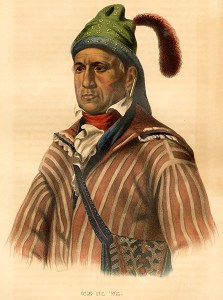
Circa 1765, Menawa was born to a Creek woman and a Scottish father in the Creek town of Okfuskee. The name given him in his youth was Hothlepoya, “Crazy War Hunter,” for his raids and exploits in Tennessee where he stole American horses. These exploits made him famous.
In 1811, he became the second chief of Okfuskee. He acquired wealth through trade, cattle and hog raising, and trading horses. During the Creek War, he lost his wealth but his political prominence and influence within the tribe continued. He died in 1836 on the Trail of Tears.
Sources
Griffith, Benjamin W. Jr. McIntosh and Weatherford, Creek Indian Leaders, Tuscaloosa and London: The University of Alabama Press, 1988.
Halbert, Henry S. and Timothy H. Ball. The Creek War of 1813 and 1814. 1895. Reprint edited by Frank L. Owsley Jr. Tuscaloosa: University of Alabama Press, 1995.
Waselkov, Gregory A. A Conquering Spirit: Fort Mims and the Redstick War of 1813-1814. Tuscaloosa: University of Alabama Press, 2006.
Links
“Menawa,’ American Battlefield Trust, https://www.battlefields.org/learn/biographies/menawa
Kathryn Braund,“Menawa,“ Encyclopedia of Alabama, updated May 16, 2019, http://encyclopediaofalabama.org/article/h-3594


 The Author's Cove: John "Jack" Cunningham on Writing & History