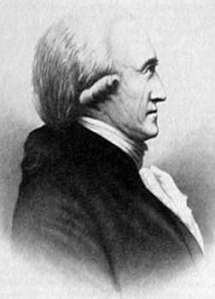
Born into a wealthy North Carolina family in 1754, Benjamin Hawkins later attended the College of New Jersey (modern-day Princeton) where he studied French. During the American Revolution, knowledge of this language served him well as George Washington’s translator until Lafayette arrived to perform that duty.
In 1778, he served in North Carolina’s House of Representatives. Between 1783-84, and in 1787, he was a delegate to the Continental Congress. In 1789, as one of 271 North Carolina delegates to the Fayetteville Convention, he voted to ratify the United States Constitution.
When he won an election to the United States Senate in 1789, he helped negotiate treaties with the Cherokees and Creeks, two of the Civilized Tribes in America’s southeastern region. President Washington appointed him General Superintendent of Indian Affairs, serving the tribes south of the Ohio River, in 1796.
To carry out his new responsibilities, Hawkins moved to Georgia and settled on the Flint River. For many years, he lived with a woman named Susan Lavina Downs and finally married her near the end of his life. Some historians believe she was Creek, though there is some disagreement on this. Together, they had seven children—six daughters and one son. During his time as an agent, he learned the Creeks’ language and became a respected member of their tribe.
When Hawkins received his appointment the deerskin economy of the Indians was coming to an end. He sought to “civilize” the Creeks by persuading them to turn to farming and cattle herding. However, these tribes were already farmers, so he encouraged them to learn how to use white men’s farming tools, such as plows, and white men’s methods of raising crops, including such commodities as cotton. He likewise wanted the women to learn how to use spinning wheels and do other things white women did. He was, in essence, trying to make them American in the hope that they’d eventually give up their culture and give their land to the white man.
THE CREEK WAR (1813-1814)
When the Creek War broke out he helped organize Creeks who supported the white settlers against those who did not (Red Sticks). He was also present at the signing of the Treaty of Fort Jackson in present-day Wetumpka, Alabama, which ended the conflict.
When explorers roamed the southeastern region of North America in the 1500s, they encountered five indigenous tribes more culturally advanced than others. Collectively, they were called the Civilized Tribes. Four resided in Alabama: the Chickasaws, Choctaws, Cherokees, and Creeks (aka Muscogees) while the fifth tribe—the Seminoles— lived in Florida. Of the four in Alabama, the Creek Confederacy dominated.
One indigenous band still resides in my state. In fact, they have a reservation not far from where I live. But didn’t President Andrew Jackson send all the state’s tribes to Oklahoma after the Indian Removal Act of 1830? Yes, he did. Well, almost. We’ll get into that later.
The tribal band that avoided the Removal Act are the Poarch Creeks. More about them later.
Creek Towns
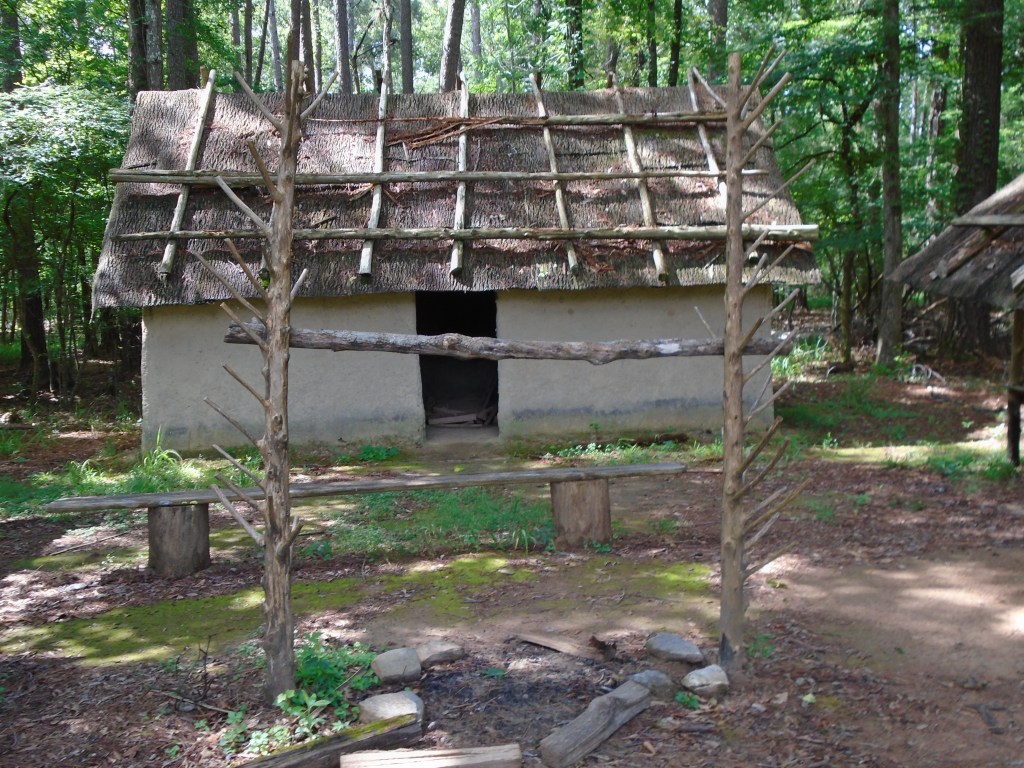
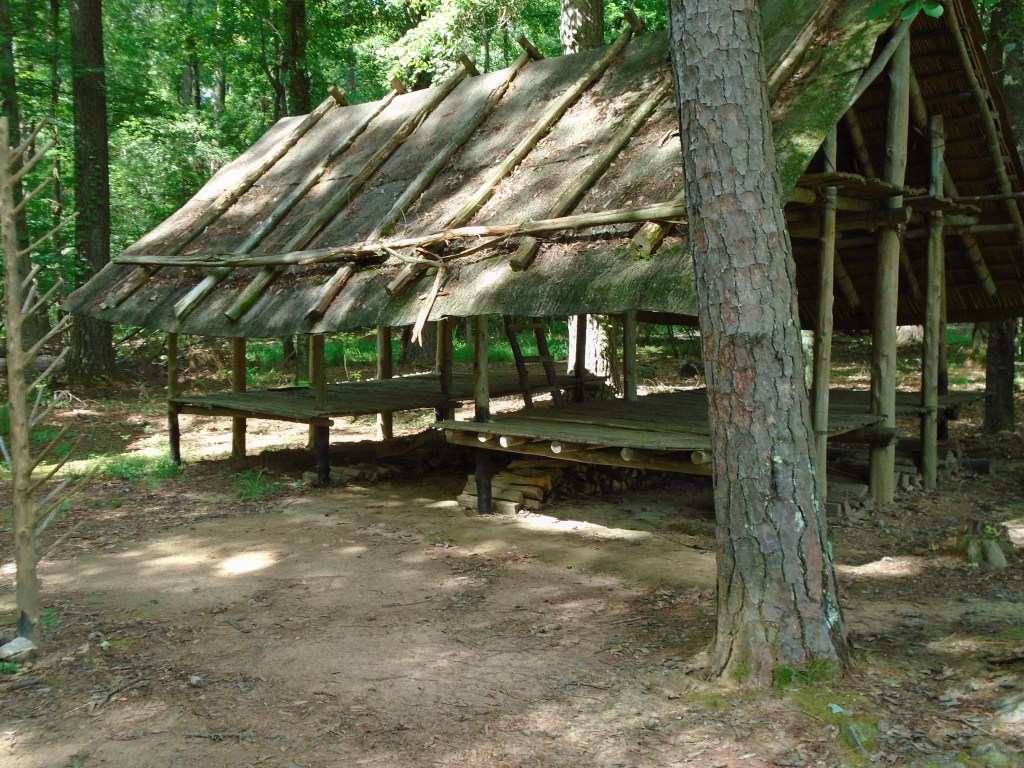
The Creeks lived in permanent towns, either in cabins with clay floors and thatched roofs or in wigwams. Each town had a square in the middle of four surrounding sheds, long and low, which served as government buildings and housing for its warriors. Inside them, tribal issues were debated and discussed, and decisions made.
As one walked off the square and past these large sheds, he/she would come upon the residential district—cabins scattered about and clustered together according to families. Some houses were built along rivers and creeks.
Creek Winter Home, Fort Toulouse-Fort Jackson, Wetumpka, AL. Photo by the author.
By the eighteenth century, the Creek Confederacy had grown to fifty towns with a population close to 20,000 people.
Creek Summer Home, Fort Toulouse-Fort Jackson, Wetumpka, AL. Photo by the author.
The Creek War (1813-1814)
Without going into detail because it’s beyond the scope of this post, war broke out in Alabama Country in 1813. The United States was already engaged in a second war against Great Britain. But this war was fought against a band of warrior Creeks called the Red Sticks, so-named because their war clubs were red. These Creeks were prophets and mystics who claimed supernatural powers.
Why did this war begin? Several factors contributed.
Settlers were pouring into the Alabama country, then part of the Mississippi Territory. This caused friction between the white men and some of the tribes.
A civil war between the tribes was starting between those who supported the white man and his culture and those who wanted to keep their ancient culture and traditions.
A Shawnee chief, Tecumseh, was an ally of the British. They sent him down from Canada to rouse the tribes in the southeast to attack settlers on the frontier. A great orator and persuader, twenty-nine Creek towns rallied to his call to eliminate the white man from their land. Five Creek towns remained peaceful, however, as did most of the Choctaws, Chickasaws, and Cherokees.
Tecumseh, drawn about 1808 and based on a sketch.. He’s around 45 years old in this picture. Credit: Wikipedia.org.
Before he went back to Canada, Tecumseh gave a prophecy: “When I return home and stamp my foot, a comet will appear in the sky and the earth will shake.” Well, both things came to pass, for British scientists in Canada had told him about the comet. As for the earth shaking, a minor earthquake did occur where these Red Stick Creeks were, but it was just a coincidence. .
The mystical Red Sticks preached war and prophesied to their people. In February of 1813, war broke out. The Creek War was a small war within the context of the larger War of 1812. It ended with a surrender to General Andrew Jackson in 1814, after his decisive victory at Horseshoe Bend. An interesting bit of trivia regarding this battle: two famous figures in the future Texas Revolution fought with Jackson here. Their names? Sam Houston, who was wounded in the battle, and Davy Crockett. On August 9, 1814, Creek chiefs signed a treaty at Fort Jackson (in present-day Wetumpka), ending the war and ceding 20 million acres of land.
The Poarch Creeks
In 1830, Congress passed the Relocation Act. This forced the Creeks and other Civilized Tribes, except the Cherokees, to leave their native land for a new territory that would one day become the state of Oklahoma. The Cherokees began getting forced out of Alabama in 1838, after Congress passed the Treaty of New Echota in 1835. All of these tribes suffered horribly, and many members perished, along the 1,000 + miles they walked. It is aptly called the Trail of Tears and it’s one of American history’s saddest episodes.
Along Alabama’s Tensaw River, however, north of Mobile, a band of Creeks loyal to the white man were allowed to remain. These had worked as traders and scouts. However, they were eventually forced to move further north. They eventually called themselves the Poarch Creeks, named for their reservation in Poarch, Alabama. They’ve lived in that state for over 200 years.
National Trail of Tears Association, “Trail of Tears Association Alabama Chapter,” Muscle Shoals, Alabama, alabamatota.com/history/
Holland, James W. Victory at the Horseshoe: Andrew Jackson and the Creek War. Tuscaloosa, AL:Eastern National with The University of Alabama Press and Horseshoe Bend National Military Park, 2004.
McMillan, Malcolm C. The Land Called Alabama, Austin, Texas: Steck-Vaughn Company, 1968
Riegel, Robert E. and Athearn, Robert G. America Moves West, Hinsdake, Illinois: The Dryden Press, Inc., 1971.


 The Author's Cove: John "Jack" Cunningham on Writing & History