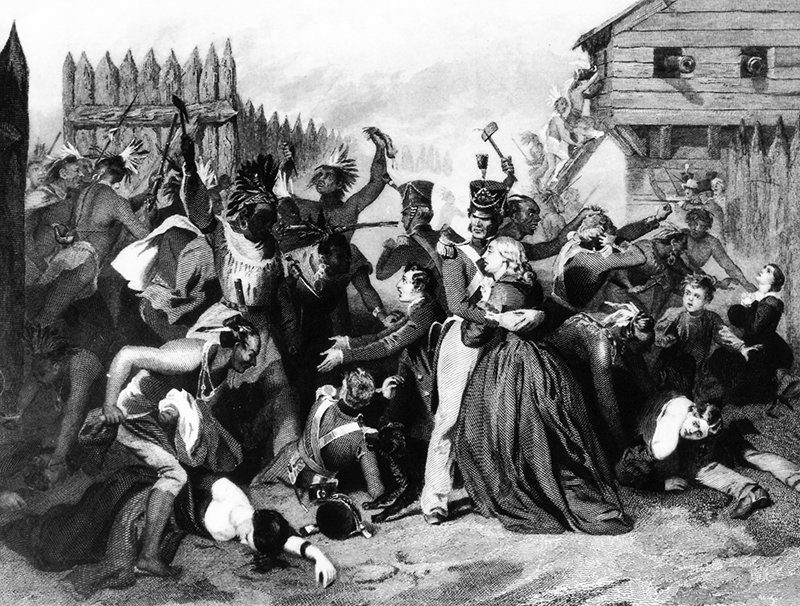
Ever since the fourth grade, when I first saw this picture in a textbook, it captured my imagination. It’s a romanticized (and inaccurate) depiction of the Fort Mims massacre that took place early in the Creek War (1813-1814) in lower Alabama. I was too young at the time to care about the inaccuracies, but throughout my life this image has stayed with me. Once I became a professional writer, I yearned to write a novel about this tragic event. What kept me from doing it after forty years of literary effort? I wasn’t sure how to begin it.
Well, coming this fall, the book will finally be released by Ashland Park Books: Frontier Circuit, A Story of the Creek War.
Meanwhile, I am currently revising a novel set in a more modern era, the 1940s and 50s.
Gideon entered the game room and strode straight to the bar to purchase a beer. Tobacco fogs swirled over tables, and lights from gaslit chandeliers danced in their mist. Murmurs punctuated whirring roulette wheels. Along a far wall, men played games of twenty-one and faro. Billiard balls cracking against each other echoed from an adjoining room.
Gideon never played roulette, though he did sometimes play billiards, and he occasionally engaged in twenty-one and faro. Poker, though, was the pastime he’d come to love. Men who stood beside him at the bar conversed while drinking their liquors of choice. The entire place smelled of beer and tobacco.
In the above scene the protagonist in my WIP, Gideon Deshler, enters a game room in antebellum Mobile’s popular gaming establishment, Shakespeare’s Row. Like New Orleans, Mobile attracted gamblers from a variety of backgrounds—gentlemen, professional gamblers, and the unsavory types.
Shakespeare’s Row, however, only catered to well-mannered and honest gamblers, those who at least appeared to be gentlemen. Troublemakers and dishonest players weren’t allowed on its premises. One writer described it as a string of brick buildings housing numerous businesses along the street, then when a person entered through one of its two arched doorways, he’d find a courtyard. In the middle of this courtyard stood a three-story building, with stairways, that housed twenty-eight game rooms facing it. Gambling activity continued there all night.
Shakespeare’s Row is one of the central settings of my novel-in-progress, tentatively titled Thoroughbreds and the Prodigal.
Sources
Amos, Harriet E. Cotton City: Urban Development in Antebellum Mobile, Tuscaloosa and London: The University of Alabama Press, 1985.
Chafetz, Henry. Play the Devil: A History of Gambling in the United States from 1492 to 1955, N.p.,Bonanza Books, 1960.


 The Author's Cove: John "Jack" Cunningham on Writing & History