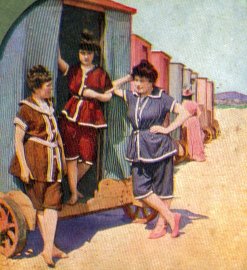
Victorian Bathing Machines

The bathing machine is believed by many to have been invented in 1750 by a Quaker named Benjamin Beale. Before the Victorian era, men and women swam and bathed in the nude. This wasn’t a pastime for them, however. People in the 18th and 19th centuries bathed for their health.

A Brief Description

A bathing machine was a small wooden house, or shed, raised high on large wheels. It had entrances front and back—either doors or canvas curtains. Also, it had steps. During the nineteenth century, its popularity grew. These small structures were often seen on American, British, and Mexican beaches. As seen in the photo below, Queen Victoria had her own personal bathing machine.

Queen Victoria’s Bathing Machine. Photo Credit: By grumpylumixuser, CC BY 3.0, https://commons.wikimedia.org/w/index.php?curid=54984764

Why They Were Invented

During the Victorian Era, mixed bathing was considered immoral. Men and women swimmers had separate beaches, or if not, they had separate sections of the same beach.

So, the bathing machine was primarily invented for women. Modesty was the rule of the era for females, and these machines gave them the privacy they needed to change out of their street clothes into their swimming costumes.

Victorian women, however, had to bathe in dresses, a cumbersome experience for them and a reason why so few of them could swim. Early swimwear consisted of ankle-length wool or flannel dresses. Like our fashions today, ladies’ swimwear changed over the decades.

“Mermaids at Brighton,” by William Heath, 1829

How Bathing Machines Worked

First, a lady would walk up high steps into the machine and through a door(or canvas cover). Inside, she’d likely find a bench to sit on and a special compartment for her clothes. She’d get out of her day dress, which she’d store in the compartment, then change into her swimming outfit. In the later 1800s, a swimming dress was typically shorter than her street dress. It also consisted of pantaloons, shoes, a swimming cap, and stockings.

After she changed, either a horse or a person would roll the machine into the sea. Then, she’d exit another door (or canvas cover) and enter the water. She’d splash around and bathe, perhaps jump a few waves while holding onto a rope attached to a buoy. When she wanted to return to shore, she’d raise a flag on the machine’s peaked roof to signal her intent. Then, either a horse or a person would draw her back onto the beach while she, inside the machine, changed back into her street clothes.

On their beaches, men sometimes used these machines as well.

In 1862, Britain passed a law that male and female bathers had to stay separate from each other by at least 60 feet. If a lady didn’t have a bathing outfit, she would be provided with one, and drawers would be loaned to men who wanted to bathe.

“Bathing Machine Gals, 1902”


Ladies Who Couldn’t Swim

For ladies who couldn’t swim in this era, they could still enjoy a refreshing dip with the help of a dipper, a strong woman who’d escort them out of the machine, into the water and dunk them.

In my current work-in-progress, I feature a bathing machine in one of my scenes. The girl you will see in this short video shows us a swimming costume that was popular in the 1870s, my current WIP’s era.

“Bringing History to Life, 1872 bathing suit’, by Ninonella

Sources

Lucy Davidson. “What was a Victorian Bathing Machine?” HistoryHit, March 2, 2022,  What Was a Victorian Bathing Machine? | History Hit

Liz T. “The Evolution of Women’s Swimwear from the 1700s to Today,” Glitz. Glam, and Rebellion. June 8, 2020, The Evolution of Women’s Swimwear from the 1700s to Today – Glitz Glam and Rebellion

—- “How did a Victorian Bathing Machine Work?” Shutterbulky. Credited to Vintage Everyday, How did a Victorian bathing machines work? Amazing facts with 25 photos – ShutterBulky

Vic, “Benjamin Beale’s Invention for the Bathing Machine,” Jane Austin’s World, August 10, 2009, https://janeaustensworld.com/2009/08/10/benjamin-beale-bathing-machines/

The Hittites

Photo by Bilge u015eeyma Ku00fctu00fckou011flu on Pexels.com

In Genesis 15:20, when God first mentions the Hittites in His covenant with Abraham, they numbered among the ten tribes that occupied Canaan. Before the turn of the twentieth century, though, skeptical scholars pointed to this passage and other Hittite references to prove the Bible’s inaccuracy. After all, they had no proof that these tribes ever existed. Therefore, they reasoned, the Bible must not be true.

Just because something isn’t proven yet doesn’t mean it won’t be in the future. The Hittites’ story illustrates this.

1871

In this year, the first evidence of their existence was uncovered at Carchemish, in Syria, on the Euphrates River.

1887

An Egyptian peasant woman, while digging for mud which she used as fertilizer, stumbled upon some clay tablets bearing cuneiform writing. They became the famous Armana letters, ancient letters written by monarchs and princes, some of them Hittite. In the picture above, we see an example of cuneiform writing.

1906-1911 & 1911-1912

Professor Hugo Winckler discovered some ten thousand clay tablets in Turkey that held cuneiform writing in several ancient languages. They provided a wealth of knowledge about these people. As it turned out, the professor had discovered a Hittite capital city, present-day Boghazkoy, Turkey, and its archives.

Before they became an empire, the Hittites scattered from Turkey and throughout Palestine. Joshua defeated the Palestinian Hittites during his conquest of Canaan (Joshua 9:1; 11:3).

The empire began around 1460 B.C. from Turkey all the way to Syria as far as the Euphrates River. Around 1200 B.C., it came to an end. As a major military power, they once overran Babylon and waged war against Egypt. Around 1286 B.C. troops under Pharaoh Ramses II clashed with Hittite soldiers at Kadesh, Syria. The battle was indecisive. Eventually, the two empires made peace when Ramses married the Hittite king’s daughter.

Sources

Gardner, Joseph L., ed. Reader’s Digest Atlas of the Bible: An Illustrated Guide to the Holy Land. Pleasantville, New York: Reader’s Digest Association, 1981.

Payne, J. Barton. “Hittites.” In The Zondervan Pictorial Bible Dictionary, ed. Merrill C. Tenney. Grand Rapids: Zondervan Publishing House, 1963.

Starr, Chester A. A History of the Ancient World. 4th edition. New York: Oxford University Press, 1991.

Unger, Merrill F. Archaeology and the Old Testament: A Companion Volume to Archaeology and the New Testament. Grand Rapids: Zondervan Publishing House, 1954.

Types of Conflict in a Story

A story without conflict is boring. A story without conflict is not a story. To keep readers engaged the writer must use conflict in every scene. Also, the conflict must be well-written, which means it must be visual and engaging. In other words, readers must see the conflict, not told it.

What is conflict? It’s a contest between two opposing forces, each force having an objective or goal. It’s not always the “good guy versus the bad guy,” though of course, it can be and often is. Let’s look at the different types of conflict found in literature. Perhaps they’ll spark some ideas.

Man versus Self

This is internal conflict. A character is struggling with issues within himself/herself. It’s a novel centered around introspection, moral choices, self-doubts, and coming to terms with oneself.  An excellent example of this is William Shakespeare’s “Hamlet.” In the play, Hamlet struggles with a moral decision – whether he should avenge his father’s murder. His indecision leads to his tragic end.

Man versus Technology

Mary Shelley’s novel, Frankenstein, illustrates this. Doctor Viktor Frankenstein creates a monster who eventually turns on him.

Man versus Nature

Jack London’s famous short story, “To Build a Fire,” is an excellent example. A man and his dog get caught in extremely cold weather in the Yukon. The man struggles to survive.

Man versus Man

This is the most often used conflict. Two characters oppose each other, and each one has a different goal. Think of it as protagonist (hero) versus antagonist (villain). They struggle against each other in various ways. Their struggles don’t always have to be physical. They can also struggle politically, morally, or even competitively.

Man versus Society

Photo by Ashley Williams on Pexels.com

 This story’s conflict centers on “man versus the world”, “man versus culture”, “man versus government”, and similar things. Characters grow and change, and these tales also carry some heavy themes. A good example of this is George Orwell’s classic work, 1984. In it, the main character, Winston Smith, opposes Big Brother and his tyrannical regime.

Literary Missionaries

Three Frustrations Authors Suffer

Photo by Andrea Piacquadio on Pexels.com

As I sit here today at my laptop, I’m frustrated. Why? Writer’s block. My “idea well” has run dry. Hey! A thought just occurred. Why not write about some of the frustrations we face along our literary journey. All right, then. Let’s begin.

Rejections

Serious writers understand that rejection comes with the territory. An oft-repeated cliché heard at conferences goes like this: “Not everyone will like our baby,” that is, “Not everyone will like our book.” It doesn’t necessarily mean our writing’s bad. It may mean our book isn’t for everyone, not even for some agents and publishers. Those of us who are called to write won’t let rejection destroy our dreams. Instead, we’ll persevere in our craft.

Finding Ideas

An affliction that affects most writers at some point or other in their careers is writer’s block. That is, their well of ideas runs dry, as shown in my blog’s introductory paragraph. How do we refill it? Here are three ways to consider.

  • Read. Spend lots of time reading. When we read, kernels of thoughts enter our minds which sometimes spread into ideas for articles, nonfiction books, short stories and novels. Don’t just read in our genres. In fact, read everything we can get our hands on. Approach reading as part of our work—because it is.
  • Pictures, photos, etc. When I was in the sixth grade, my teacher had what she called a “writing table.” Lots of pictures were on it, some cut out of magazines. She’d give those of us who wanted to do so a chance to pick out a picture and write about it. I remember cutting out an advertisement—the photo of a cow standing in front of a commercial airliner. I probably used this table more than my classmates. By studying pictures closely, we may be prompted to write something that inspires us.
  • Experience Life. I love to travel and explore new places. Often, these provide ideas for me as well. When your idea well dries up, consider going to a place you’ve never been before. Take a few days off to walk around and explore it. Who knows? That place may be an excellent setting for a new story.

Finding Time

Truthfully, it’s usually not a matter of “not having time.” It’s a matter of “making time,” and serious writers make time if only thirty minutes or less a day. Of course, sometimes things happen out of our control and our schedule is so full we truly don’t have time to write. That said, truly “not having time” should be the exception to our schedules, not the rule. Make writing a habit. Get up earlier than usual, or go to be later than usual if need be. Practice becoming a writer who takes his/her craft seriously. Don’t let anything discourage you in your literary calling.

Literary Missionaries

Photo by Pixabay on Pexels.com

Chunkey, Anyone? Another Popular Native American Sport

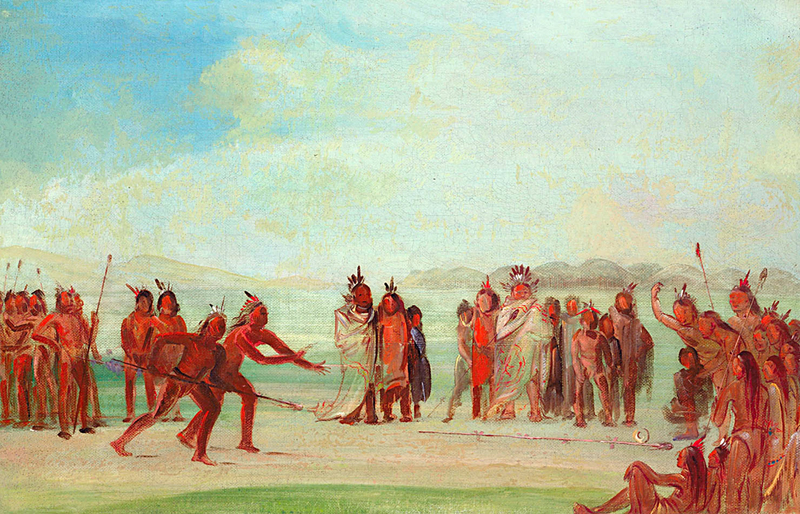
Painting by George Caitlin. Mandans playing Chunkey

Chunkey, an ancient Native American sport, is enjoyable for everyone. Also, it’s easy to play. The game goes back at least as far as the 7th century A.D.

Much like stickball, Native American tribes, particularly those in America’s Southeast, played this game to settle disputes. They took this game seriously and even played it to gamble. Quite a few players lost everything in their wagers, sometimes with even more tragic consequences such as suicides. Today, it’s usually played for fun.

Below is a basic overview of the game. The Native Americans then and now play different variations of the game and have different methods of scoring.

Playing Field

  • In previous centuries, the tribes played it on a hard surface, such as packed clay.
  • Nowadays, it’s played on grass.

Equipment Needed to Play

  • Hickory or popular spears that are eight to ten feet long. These are called chunkey (pronounced ‘tchung-kee).
  • Round chunkey stone, sometimes with a hole in it. These were often made of sandstone, clay or granite.

How the Game is Played

  • A player rolls the chunkey stone across the playing field underhanded, like a bowling ball.
  • Players with spears hurl them at the stone. The player whose spear came closest to the stone scores a point.

Famous American painter and artistic chronicler of the West witnessed this game, as seen in his painting at the beginning of this post, He recorded what he saw in writing as well.

The game of Tchung-kee [is] a beautiful athletic exercise, which the Mandan seem to be almost unceasingly practicing whilst the weather is fair, and they have nothing else of moment to demand their attention. This game is decidedly their favourite amusement, and is played near to the village on a pavement of clay, which has been used for that purpose until it has become as smooth and hard as a floor. … The play commences with two (one from each party), who start off upon a trot, abreast of each other, and one of them rolls in advance of them, on the pavement, a little ring of two or three inches in diameter, cut out of a stone; and each one follows it up with his ‘tchung-kee’ (a stick of six feet in length, with little bits of leather projecting from its sides of an inch or more in length), which he throws before him as he runs, sliding it along upon the ground after the ring, endeavouring to place it in such a position when it stops, that the ring may fall upon it, and receive one of the little projections of leather through it.

— George Catlin, 1832

Sources

Lindsey Bark, “Chunkey: A Game of Stones,” Cherokee Phoenix, August 27, 2020, Chunkey: A Game of Stones | Culture | cherokeephoenix.org

Anne Gregory, Chunkey, Cahokia, and Indigenous Conflict Resolution (Thesis), Scholar’s Bank, University of Oregon, September 25, 2020, Chunkey, Cahokia, and Indigenous Conflict Resolution (uoregon.edu)

E. Metcalf, “Chunkey: More Than Just a Game,” Real Archaeology(blog),November 5, 2023, Chunkey: More Then Just a Game | Real Archaeology (vassar.edu)

Being Professional


Blog Writer
With today’s technology, it’s become easier for wannabe writers to see their work published. Indeed, thousands of books are out there clamoring for readers’ attention. The ease with which publication has become, though, presents its own issues for self-published authors.

We must understand that professional writing demands more than just sitting down at our laptops, whipping out a manuscript, and then self-publishing it. It goes well beyond that first draft, second draft, even third draft. It takes long hours of hard work and revision till we’ve finally polished our prose.

Just as we can’t repair a car if we don’t understand how its engine works, so we can’t engage in effective revision and polish if we don’t understand what makes good writing work. Effective writing entails numerous elements, and each element requires constant practice. For serious authors, writing is a daily discipline. Professional writers don’t wait for the inspiration bug to hit them. Professional writers write! 

Do we want our self-published books to stand out among all the other indie books on the market? Do we want to be taken seriously as authors? Do we want to sell our books? If so, we must approach our craft the same way all serious writers approach it— through disciplined study, practice, and, of course, writing on a regular basis. 

.