The Writer’s Warehouse


man riding on yellow forklift
Photo by ELEVATE on Pexels.com

When we look at our manuscript’s pages, imagine them as a verbal warehouse. A literal warehouse uses different machines for lifting different types of products. Neat warehouses, like neat writing, are well-organized. Some machines, such as forklifts, can lift heavier items than other machines, such as hand trucks.

The same is true in our English language. Some parts of speech are forklifts, others hand trucks. Our language also has “pasteboard” boxes, as we shall see.

The Forklifts: Nouns, Pronouns and Verbs

These parts of speech, if well-chosen, do the heaviest lifting in a sentence.
More often than not, hand trucks aren’t needed.

The Hand Trucks: Adjectives and Adverbs

Sometimes, though, these verbal hand trucks are needed. When? When concrete nouns and dynamic action verbs alone can’t create a precise image in readers’ minds.

Pasteboard Boxes: Prepositions and Conjunctions

Every warehouse I’ve ever been in has merchandise in boxes, usually pasteboard boxes. These keep the merchandise clean and well-organized. Similarly, verbal “boxes” are necessary to help our sentences flow smoothly and clearly by keeping them well-organized. But do they pack a lot of weight? Most often, they don’t. But we do need them, and when we use them with “forklifts” and “hand trucks,” they help make our sentences the strongest and clearest they can be. Use them carefully, though. Too many in a sentence can also cause clutter.

Examples

1. The horse ran very fast through the field.
2. The thoroughbred galloped through the cotton field.
3. The brown thoroughbred galloped through the cotton field.

Which of the three sentences is the strongest? The third one, because it creates the most visual image in the reader’s mind.

Sentence 1: 

“horse” and “field” – too general. We don’t know what kind of horse, nor do    we know what kind of field the horse ran through.

 “very fast” – also too general. How fast is “very fast”? More often than not,  “very” isn’t needed, so be on the lookout for this adverb.

“through” – this preposition, though lightweight, is needed for clarity. It shows us the direction the horse is running.   

Sentence 2:

“thoroughbred” – a strong concrete noun. Here, we see a specific breed of  horse.                      

“galloped”  — more specific. We can see how fast the horse is running.

 “cotton field” — more specific/concrete. We can also visualize the field.

Sentence 3:

“brown” – an adjective that’s needed. Because thoroughbreds come in several colors, “brown” helps readers visualize the horse even better.  

Coming next week, an interview with Jodie Wolfe. author of To Claim Her Heart, a novel set during the Oklahoma Land Rush. Be sure to visit the Interview page next week to read it.


Cicero’s Take on History and Historians


CiceroBust

The first law for the historian is that he shall never dare utter an untruth. The second is that he shall suppress nothing that is true. Moreover, there shall be no suspicion of partiality in his writing, or of malice.” Marcus Tullius Cicero (106-43 B.C.)

As a historian and historical fiction writer, I’ve always loved this great Roman statesman’s quote.  If we aren’t objective in our study of history, if we twist the facts or rewrite history to suit our own opinions about the past, we not only cheat ourselves–we also fail to learn our ancestors’ past lessons that we can apply to today’s events.

We historical fiction writers should strive for objectivity, which also means accuracy. While weaving our fictional characters’ stories into historical events, we should accurately depict these events and the historical figures involved in them.

Is it ever acceptable to engage in a bit of artistic license? Maybe twist a small fact? I believe it’s acceptable, but shouldn’t  be done often. Bernard Cornwell shows us how to do this in his novel, Redcoat, set during the American Revolution. In a historical note at the end of the book, he tells readers that he took “some liberties with the Revolution’s chronology,” and then he explains what these liberties were. So if we do engage in a bit of license, follow Cornwell’s example and let your readers know.

Cicero’s advice is sound, though. We historians and historical fiction writers do well to heed it.


Historical Novels: Their Importance


Louis_L'Amour

“Historical novels are, without question, the best way of teaching history, for they offer the human stories behind the events and leave the reader with a desire to know more.”

Louis L’Amour (2008). “Education of a Wandering Man”, p.15, Bantam

Mister L’Amour’s words have proven true in my life. My three favorite genres have always been history, historical fiction and biographies, even as a child.

The historical fiction books I read during my growing-up years, such as The Horse Soldiers (Harold Sinclair), The Black Arrow (Robert Louis Stevenson), and The Count of Monte Cristo (Alexandre Dumas) spurred my youthful hunger for more knowledge about these books’ eras. Getting lost in the past was, for me, sheer joy.

Sadly, many people today have little knowledge of the past. They learn their history from “historical” movies, most of which aren’t entirely accurate. It’s become easier to watch a film than it is to read.

So, we historical fiction writers have a challenge. Our writing must be at the “top of our game.” Not only must we write well, we must also keep our facts accurate. Our books may not win a Pulitzer Prize write like Michael Shaara’s The Killer Angels, about the Battle of Gettysburg, but if our historical novels get more folks interested in learning about the past, our time and labor is worth it. 

Research, write, and read! Till next time, friends. Have a great week.

Books

The Author Who Lived in His Pajamas

What do you do when you’re wearing pajamas? Do you go to bed, as I do, or do you go to work in them? This question may sound stupid, and the answer obvious. But such is not the case for one famous author—Shelby Foote.

Shelby_Foote

Mister Foote once told The Paris Review that he lived in his pajamas. In other words, he wore them almost all the time at home. Another peculiarity about this famous twentieth century writer and friend of William Faulkner—he wrote with a dip inkwell pen.

Oh, he’d eventually type out his manuscripts, but when he whipped out his first drafts these pens were his preferred writing tool. He considered himself a novelist. And he was, having written five novels in five years. The French and Italians loved his books, all of them bestsellers in their respective countries.

However, in the United States, he wasn’t well-known until late in life. Thanks to his famous trilogy, The Civil War: A Narrative, he’s recognized in the States as a historian. He spent twenty years living in his pajamas while writing this massive series…with a dip inkwell pen.

What brought him to literary prominence in the States? Ken Burns’s television documentary, The Civil War (1990). In this series, Foote provided major commentary. His physical appearance and Mississippi drawl…It was as though he’d fought in that war himself and then stepped through a time machine to tell us “moderns” about it. Because of his “stardom” in this documentary, sales of his trilogy soared.

He passed away on June 29, 2005, at the age of eighty-eight.

Source

Coleman, Carter and Donald Faulkner and William Kennedy. “Shelby Foote, The Art of Fiction No. 158.” The Paris Review, Issue 151 Summer 1999, http://www.theparisreview.org/interviews/931/shelby-foote-the-art-of-fiction-no-158-shelby-foote.


Indie versus Traditional Publishing: My Thoughts on the Subject

Books

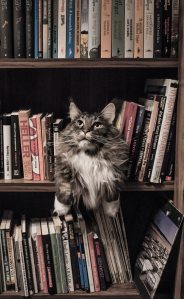
cat and booksMany years ago, what I often call those “typewriter days,” I taught a writing class where I often warned my students about subsidy publishers. I always advised going the traditional route. What is a subsidy publisher? It’s a company that promises huge royalties (such as seventy percent of the retail price) and makes its authors pay thousands of dollars to be published. It’s not illegal, because these companies do follow-through with their publishing commitments.

However, no bookstores stock their books, which explains why they can promise huge royalties. Why don’t bookstores carry their titles? Because, so long as authors pay them, they publish every manuscript submitted to them regardless of the book’s literary quality. These publishers make money off the author, not off the few customers who buy their books.

As for traditional publishers, their royalty payments usually start at ten percent of a book’s retail price. Also, they don’t accept every manuscript that crosses their editors’ desks. Always on the lookout for well-written, marketable books, nowadays these publishers also consider the size of an author’s platform.

For some traditional publishers an author’s platform is the first thing they consider, something I recently learned at a writers’ conference. During the typewriter days, these publishers usually looked at an author’s literary background and bylines first. Oh, how things have changed!

Balanced Publishing

Fast forward to the “internet days.” Along came Amazon, Book Baby, Lulu, and similar self-publishers. Now anyone can have their work published. Because I’ve been published both ways, traditional and indie, I see advantages and disadvantages to each approach. So, why not go both routes? I would, and I do. Let some books find a traditional publisher, and let others be indie-published. This is a good balance between the two, I think.

What I love most about being indie published, though, is its freedom. Freedom to write what I want, and freedom from worry about query letters, synopses, outlines, searching for agents, etc. I know my book will be published…by me! Thus, I can focus even more on the quality of my writing. And herein lies the main problem I see with numerous indie books—so many are poorly written.

It’s imperative that we indie authors produce quality material written at a professional level. Amateur writing not only reflects badly on us, it also reflects badly on the self-publishing industry, and it hinders our chances that customers will purchase our future books.

Read the next section for tips on how to be a good indie author.

How to be a Good Indie Author

1. Study hard. Just because it’s become easier to get published doesn’t mean everyone    should do it. Study the craft, practice the craft. Take writing classes, subscribe to writing magazines, read websites that discuss writing. We must learn everything we can about it.

2. Work hard. Revision holds the key to literary excellence but unless we know what things to look for, which comes through study, we won’t know what to change. Never be satisfied with a first, second, or even a third draft. Once we’ve finished our work, put it aside for a few weeks then return to it. It always surprises me how many things I catch that need fixing when I do this. Input from those in writers’ groups also helps.

3. Get bylines. What’s a byline? It’s the author’s name on a published work. When we reach the point where we can sell our work to traditional magazines and such, we know we’re starting to write at a professional level. It is then that we should consider going indie. This, of course, is my own opinion.

4. Find professionals. Once we’ve honed our manuscript to the best of our ability,  hire these three professionals for the final touches: (1) Freelance editors, (2) cover designers, and (3) interior formatters.

Freelance Editors–If spelling and grammatical errors riddle our prose, our book   shouts “amateur” at the top of its lungs. Another benefit of good freelance  editors?  They’ll offer us honest feedback that will help us improve our work.

Cover Designers–Don’t underestimate a book cover’s importance. Good covers prompt potential readers to open our book and consider purchasing it.

Interior Formatters–Finally, if the book’s interior formatting is shoddy, “amateur” once again sounds loud and clear.

Where’s a good place to find these professionals? I recommend upwork.com.

Well, much more could be said on this subject. I may have more to say in future posts. Meanwhile, what are your thoughts on this subject?

Till next time, folks. Have a great week!

Let’s Have a Conversation


Placeholder ImageHas anyone ever told you that  you write like you talk? That’s a great thing to hear if they did. Indeed, it’s a compliment, because good writing carries with it a conversational, natural-sounding style, whereas poor writing is stilted and sounds forced. Stilted writing bores readers, whereas conversational writing pleases them, thus encouraging them to keep reading.
What is stilted writing?

1. Stilted writing sounds formal. It uses formal words instead of the everyday words most people use.

2. Stilted writing doesn’t use contractions.

   a. Stilted sentence: “I am sorry I was late.”

   b. More natural sentence: “I’m sorry I was late.”

3. Read your prose aloud. Better yet, read it into a voice recorder, then play back what you’ve read. Does it sound like natural conversation? If so, great! If not, more work needs to be done.

As writers, then, let’s aim for a conversational style. It should sound like we’re talking to readers from an easy chair, telling them a story. To achieve this requires lots of work and lots of practice. Here are a few tips that’ll help.

1. Use contractions. Why? Because people use contractions in their everyday speech.

2. Vary sentence lengths but be concise. Good writing makes every word count toward the reader’s understanding of a sentence no matter what the sentence’s length. If a word or phrase doesn’t contribute toward understanding a sentence’s meaning, if it’s just hanging out there serving no purpose, get rid of it.

3. Vary our sentence structures. Since sentence structure is beyond the scope of this post, I recommend finding and studying a good grammar book that discusses it.

Till next time, friends, keep on writing!

An Early Writing Lesson

Many years ago, make that back in the early 1980s, I started taking my writing seriously after having a small article published in The Upper Room, a United Methodist devotional magazine. One of the early lessons I learned then was this: many folks either shrugged at my desire to become a writer, or thought I was lazy when I decided to launch out on my own and try my hand at it full-time. Fortunately, some of my early writing teachers had taught me to expect this reaction. Had it not been for their warnings, I might have become discouraged and quit. Writing, I discovered very quickly, is a lonely and hard business.

Blog Typewriter 2On the other hand, it had become such a passion that I gave up certain activities in order to pursue it. My biggest activity I gave up was my Saturday golf outings with friends. They didn’t understand. No one did. But that’s all right. The Lord has enabled me through all these years to “roll with the punches.”

I think one reason why the average person doesn’t understand the work involved is because when they see it in print, good writing looks easy. Oh, but quite the opposite is true. The easier a published work is to read, the harder its author worked. We writers can’t write well if we don’t work hard.

Don’t let naysayers discourage you from your calling. Our God is good, and He will bring your literary dreams to pass if you continue to believe Him and persist toward your goal.