As stated in my previous post, character biographies are essential to creating three-dimensional characters.
Another technique for 3D characters: give ’em quirks. A quirk can be anything from being obsessive about punctuality or neatness to flopping on a couch first thing every morning to watch ESPN or always walking around the house barefoot. The late, great American novelist and historian, Shelby Foote, once said in an interview that he wrote in his pajamas. Now I’d call that a quirk.
So, give each of your characters habits and traits that are peculiar to them.
For example, C.S. Forester’s naval hero, Horatio Hornblower, possesses a quirk about baths–he likes having his men hose him down on deck whenever he takes one.
Rex Stout’s fictional detective, Nero Wolfe, is a homebody. He’d rather tend his orchids than step outdoors onto the busy streets of New York. His assistant, Archie Goodwin, does all of the running around and investigating.
Observation of people helps us create similar believable, and quirky, characters. How do others talk? What mannerisms and gestures do they use? Any pet words or phrases? Any quirks? Keep a running list of these things. That way, they won’t be forgotten, and then we can turn to them when we write our character biographies. Let each character be his/her own unique personality.
So, give ’em some quirks. Make each character his/her own unique personality, then watch them jump off the page.
All right, here comes my confession. During my early writing years, when I began writing fiction, I struggled with creating believable characters, particularly female characters.
Olivia d’Haviland and Errol Flynn in Captain Blood. The novel was written by Rafael Sabatini.
I erred in numerous ways, and it took me many years and much practice to hone my skill. Yet even as I write this, I’m still learning and honing. For me, of all the elements of fiction, good fiction, characterization is the hardest.
When characters are well-written, they’re three-dimensional. They seem to leap off the page. This doesn’t just happen, though. It takes lots of thought, lots of planning, and lots of mental “elbow grease.”
One key to creating these “living, breathing” characters is by getting to know them. Who are they? What motivates them to do what they do? Are their motives believable? What are their likes and dislikes? Where were they born? How old are they? What level of education do they have? Where were they educated? What events in their past influenced how they now behave? These are just a few questions we must ask when drawing our characters with words.
We don’t have to answer every question in our story, but knowing our characters’ backgrounds and what makes them tick is crucial if we want them to be three-dimensional instead of cardboard cutouts.
What’s the best way to get to know them? Write their biographies.
Must we write a biography of every character, major and minor? We can, but I’d concentrate on the major characters.
Is there a short way to do this? Yes, though it’ll still require some thought. First write a list of important questions about your characters, then go back and answer them. This will start you on the right road toward toward getting to know them.
These character questions also help us keep our story consistent throughout it. For instance, if we’re writing about a character named Mary and we forget her eye color, we can refer back to the “Mary Bio Questions” to find it.
A Few Questions for Our Characters
Birthplace:
Age:
Nationality/Race:
Height:
Weight:
Physical Build:
Eye color:
Hair color/Hairstyle:
Shape of face:
Father’s name/Occupation:
Mother’s name/Occupation:
Education:
Religion:
Personality:
Admirable traits:
Negative traits:
Likes/Dislikes:
Bad habits/vices
Best thing that ever happened to them:
Worst thing that ever happened to them:
This list, of course, can be expanded, and it’s something I recommend. If you haven’t already done so, try it. It’s well worth the effort and, in the long run, saves time on revision.
Antagonists aren’t always villains. An antagonist can also be a situation, an animal, a government or institution, or anything the hero must overcome before achieving his/her goal. In this post, the antagonist I’ll be discussing is the bad guy. Without an antagonist, we have no conflict, and without conflict, we have no story.
Richard Widmark as Tommy Udo, Photo Credit: Npsaltos62
One of film’s most memorable villains is Tommy Udo, played by Richard Widmark in Kiss of Death. Who can forget that famous scene when Udo, a psychopath, shoves a lady in a wheelchair down a steep flight of steps to her death? He even laughs while he does it.
Villains should present serious challenges to the hero. He may even be superior to him in some ways, thus forcing the hero to struggle harder. For instance, the villain may be smarter or physically stronger than the hero, or perhaps he can be a Houdini-type—an escape artist.
Make your villains as loathsome as Udo, but keep them believable.
Two Tips For Believable Villains
1.Let him justify his actions. Give him believable motivations.. Readers may not think his motives are justified, but he does. Get inside his head to understand where he’s coming from. Is he greedy, vengeful, a bully? Why is he this way? Perhaps he was born into poverty or was picked on when he was a child.
2. Soften him up. Although he may be a bad guy, show a few positive traits. Perhaps he’s a true gentleman around the ladies, or maybe he has a great sense of humor or works hard. If he’s too soft, however, readers will sympathize with him, and this is something we do not want.
Villains are fun to write. Make them evil, yes, but also believable. I hope these two tips prove helpful.
While growing up in the 1960s I, like most boys, read lots of comic books. Batman was my favorite superhero. I never much cared for Superman, however, because he was just…well…not someone I could believe existed. At least Batman, behind his cape and cowl, was an actual person named Bruce Wayne.
Even so, our novel’s protagonist (hero) must be believable and someone with whom readers can identify and care about. In other words, they should be likeable. Also, introduce them in the story’s first scene.
Give the protagonist weaknesses and flaws. They can be major flaws, such as having them be workaholics, or minor flaws. For instance, in the series Columbo, Peter Falk’s character is usually unkempt and almost always wears a raincoat, even when it’s not raining. His sloppy exterior, though minor, is a flaw. Yet, we all love him and pull for him to find the murderer.
Another way to make our protagonists believable is to have them break a stereotype. This also adds more reader interest. One example would be an athletic hero, a former Olympic boxing champion who grew up in the slums and is now a detective. He enjoys reading highbrow novels and can quote Shakespeare. Have him do something likeable in his first scene. For example, let him deliver roses from his garden to one of his elderly neighbors before he deals with a homicide. Then, as the story progresses, bring in other positive traits. Does our champion love children? Does he take care of an autistic son? Such positive traits can create subplots and help deepen our story as well as our protagonist. And they make him likeable.
Once again, don’t make our hero perfect. Imperfect but likeable—that’s the key.
I’m no great intellectual, though I do enjoy reading highbrow literature on occasion. Especially, Russian literature—Leo Tolstoy and Alexander Pushkin are my favorites. By highbrow, I mean those literary classics of yesteryear with long paragraphs and sentences, multisyllabic words one seldom reads in modern works, and lots of narrative—a style we twenty-first century writers should shy away from.
I first gained an interest in highbrow literature when I was a youth and read Alexandre Dumas’s The Count of Monte Cristo. To this day, it remains one of my favorite novels.
When I studied Russian in college and took a Russian literature class…well…I discovered that I enjoyed Russian authors too.
So, here I am, and I recently finished reading Tolstoy’s Anna Karenina, Tolstoy’s last novel before his spiritual conversion. He was married in 1862, to Countess Sonya (Sofia) Behrs, but his conversion created problems which led to their divorce.
Basically, the storyline goes this way: Anna Karenina, a young woman of wealth married to Alexey Karenin, a government official in St. Petersburg who moves in high society, falls in love with a Russian army officer, Count Vronsky. Contrasted with her is a country gentleman, Konstantin Levin. Anna falls into sin and commits adultery with Vronsky whereas Levin, who harbors doubts regarding Christianity, eventually marries devout Princess Kitty Shtcherbatskaya and comes to faith in the Lord. Levin’s lifestyle is successful, Anna’s is destructive and by the end of the story she throws herself in front of an oncoming train—the consequences of her sin.
What stood out most to me about this book were its spiritual themes: hypocrisy and faith, marriage and family. This novel does not contain sex, nor does it use profanity, and Anna Karenina is considered one of the greatest novels ever written.
Tolstoy proves it, then. He wrote a clean novel that’s one of literature’s greatest works. This shows us that if we write well, we don’t need to include anything off-color. Tolstoy did it. So, perhaps we’ll write a clean, great American novel one day. We’ll never know if we don’t try.
Are you willing to try it?
In the novel, Anna is a brunette, just as we see Keira Knightly is, playing her here.
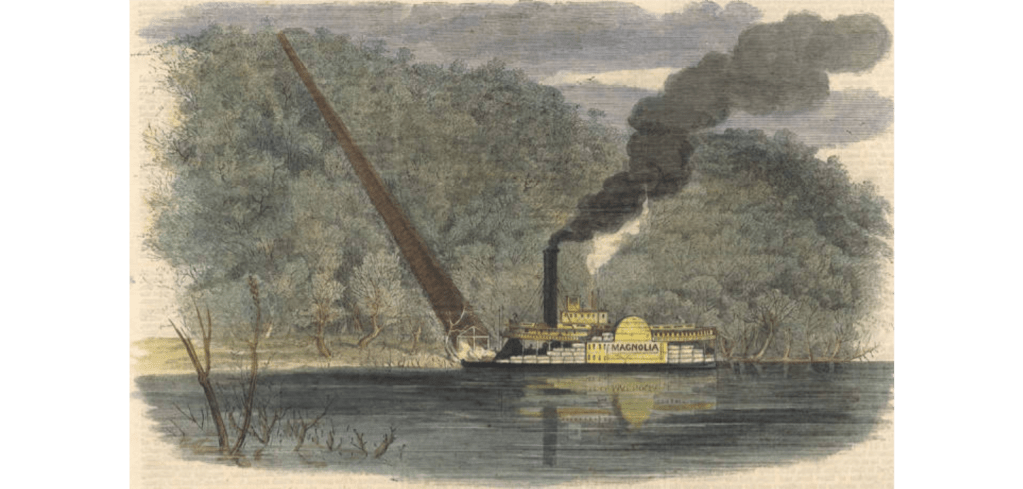
The steamboat’s paddlewheels revolved and slapped water, propelling her down the Alabama River. Atop her roof, her captain kept alert while a pilot steered her toward a high bluff on the right bank. Beneath this bluff was a landing, one of over three hundred landings on this river, and atop the bluff were warehouses holding bales of cotton and other freight.
His hands on the boat’s enormous wheel, the pilot carefully maneuvered her to the designated wharf. Although the roof captain commanded the vessel, the pilot was also considered a captain and sometimes, in certain conditions and according to law, the roof captain had to obey the pilot’s orders.
White deck hands, under the supervision of a mate, leapt off the boat and secured lines to the wharf. Rolladores—slaves ashore—hastened toward the warehouses. From here, they unloaded freight and rolled it down a long plank, or cotton chute, to the landing where stevedores, most of them Irish, proceeded to load it onto the vessel’s lowest (main) deck. Roustabouts, who were also slaves, assisted them.
Cotton chute on the Alabama River, 1861. Courtesy of Alabama Department of Archives and History
Passengers on the boat’s middle, boiler deck observed this activity from the boat’s gallery. Other passengers socialized in her saloon. While these passengers discussed all manner of things the boat’s crew, free blacks under a steward’s supervision, kept busy— the cook and his assistants prepared supper, the chambermaids cleaned cabins, the barber cut passengers’ hair, the laundress washed clothes, and the bartender served drinks to thirsty travelers. These workers oftentimes helped slaves escape to freedom.
While all this activity continued, other officers engaged in their duties. The engineer inspected the boat’s engine to be sure it remained in good working order. If it needed more wood for its boilers, he sent his firemen ashore to get it from the wood stacked on the landing.
And the clerk, with his ledgers, figured the trip’s expenses. Since he was the vessel’s business manager, he handled all of the vessel’s financial matters.
With her cargo finally loaded, the roof captain gave the order to shove off. The pilot steered the boat back into the middle of the river and continued down it to his next stop, one after the other, until she at last reached Mobile. ‘
A steamboat’s blast rent the starless evening sky; sparks tossed up like confetti. Its passengers spun and turned and glided to the music of an orchestral waltz.
More blasts erupted from the steamboat’s boilers, louder this time. And more sparks flew. Still the dancing and music in the boat’s saloon continued. Why should we be concerned? This is what these passengers thought. We enjoy dancing to Strauss.
Well, in some instances they should be concerned. Steamboat explosions frequently happened in nineteenth century America. But in the case described above, this steamboat wasn’t about to explode. It was “venting” itself on its way to a landing on the Alabama River. Such noises, and the sparks, were expected. So, its passengers danced the night away.
Though no one is sure of the exact date steamboats first plied Alabama’s rivers, the steamboat era began almost at the same time it became a state (1819), and by the 1820s steamboats became a common mode of travel on its fourteen major rivers. In the early years of steam-boating, three Alabama companies built them. Later, by 1861, Cox, Brainerd, & Company pretty much monopolized Alabama’s steamboat trade.
As these boats churned the rivers toward the port of Mobile, they’d stop at numerous landings situated below bluffs to take on cotton, which was then loaded on its lowest deck, called the main deck. Second-class passengers had to tolerate the discomforts of this deck, for on it were the vessel’s engine and kitchen as well as cotton bales, firewood, animals, and similar freight.
The wealthier passengers traveled in more luxury on the boat’s middle deck– the boiler deck, which held its saloon and cabins. British passenger, Sir Charles Lyell, described one Alabama boat’s saloon in his work, Second Visit to the United States (1849): …The upper deck is chiefly occupied with a handsome saloon, about 200-feet long, the ladies’ cabin at one end, opening into it with folding doors. Sofas, rocking chairs, and a stove are placed in this room, which is lighted by windows from above. On each side of it is a row of sleeping apartments, each communicating by one door with the saloon while the other leads out to the guard, as they call it, a long balcony or gallery, covered with a shade or verandah, which passes around the whole boat…
Saloon of Alabama steamboat Grand Republic, 1880. Courtesy of Alabama Department of Archives and History
On the third deck, the hurricane deck (aka Texas deck) the boat’s officers lived. Their quarters, flanked by smokestacks, were called the Texas. Finally, atop this deck was the pilot house. In his classic work, Life on the Mississippi, Mark Twain described the pilot house as being as “a sumptuous glass temple; room enough to have a dance in.”
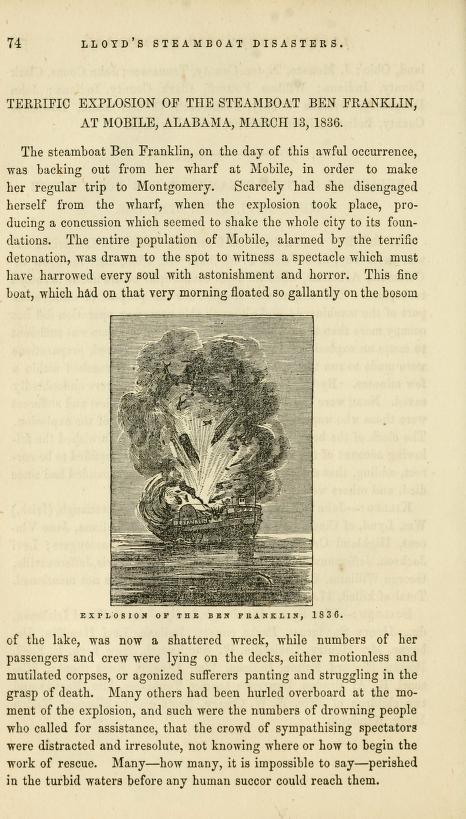
And as mentioned earlier, explosions were a real danger on these boats. Below is an article about a steamboat tragedy in the port of Mobile. The accident was believed to have been caused by its boilers not having enough water.
Griffith, Lucille. Alabama: A Documentary History to 1900, University, Alabama: University of Alabama Press, 1972.
Lyell, Sir Charles, Second Visit to the United States, vol. 2, London: J. Murray, 1849, quoted in Alabama: A Documentary History of the United States to 1900, University, Alabama: University of Alabama Press, 1972.
McMillan, Malcolm C., The Land Called Alabama, Austin, Texas: Steck-Vaughn Company, 1968.
During my thirty-plus years of writing, I never entered a writing contest… until recently. Why not? One word—fear. As a child, I was usually one of the last children who got picked at recess for softball and other competitive activities. Oh, I did win a few board games and such, so I’m only speaking in general terms. But the truth is, I simply wasn’t very good at much.
So, when it came to writing contests, I shied away from them. I feared that losing would cause me to quit writing altogether, which I did not want to do. In recent years, however, I’ve entered a few. Have I won any? Nah! But my novel, Vengeance & Betrayal, was a finalist once. Because I have lots of bylines and publishing credits now, losing doesn’t bother me. Hey, winning wouldn’t be so bad either.
Contests, I’ve learned, are a great motivation for doing our best work. Sometimes, the judges will give us a critique to help us improve. And if we’re a finalist or winner, it encourages us to keep at it. But if we lose, well, don’t get discouraged. Learn from that and work harder at the craft. I’ve discovered that contests are fun!
Having said that, because I’m a Christian as well as a writer, I see my writing as a ministry. If God has called us to be writers, we can enter contests, of course, especially those that involve our published works. However, our motivation and purpose should go beyond winning them. If all we’re concerned about is winning contests, we miss the point of our calling. Though they are great and can be rewarding, eternal rewards are in store for those who write for Christ’s kingdom from a heart that seeks to win others to Him.
So, let’s check our motivations. For whom do we write? For ourselves and earthly rewards or for Christ?
Gideon entered the game room and strode straight to the bar to purchase a beer. Tobacco fogs swirled over tables, and lights from gaslit chandeliers danced in their mist. Murmurs punctuated whirring roulette wheels. Along a far wall, men played games of twenty-one and faro. Billiard balls cracking against each other echoed from an adjoining room.
Gideon never played roulette, though he did sometimes play billiards, and he occasionally engaged in twenty-one and faro. Poker, though, was the pastime he’d come to love. Men who stood beside him at the bar conversed while drinking their liquors of choice. The entire place smelled of beer and tobacco.
In the above scene the protagonist in my WIP, Gideon Deshler, enters a game room in antebellum Mobile’s popular gaming establishment, Shakespeare’s Row. Like New Orleans, Mobile attracted gamblers from a variety of backgrounds—gentlemen, professional gamblers, and the unsavory types.
Shakespeare’s Row, however, only catered to well-mannered and honest gamblers, those who at least appeared to be gentlemen. Troublemakers and dishonest players weren’t allowed on its premises. One writer described it as a string of brick buildings housing numerous businesses along the street, then when a person entered through one of its two arched doorways, he’d find a courtyard. In the middle of this courtyard stood a three-story building, with stairways, that housed twenty-eight game rooms facing it. Gambling activity continued there all night.
Shakespeare’s Row is one of the central settings of my novel-in-progress, tentatively titled Thoroughbreds and the Prodigal.
Sources
Amos, Harriet E. Cotton City: Urban Development in Antebellum Mobile, Tuscaloosa and London: The University of Alabama Press, 1985.
Chafetz, Henry. Play the Devil: A History of Gambling in the United States from 1492 to 1955, N.p.,Bonanza Books, 1960.
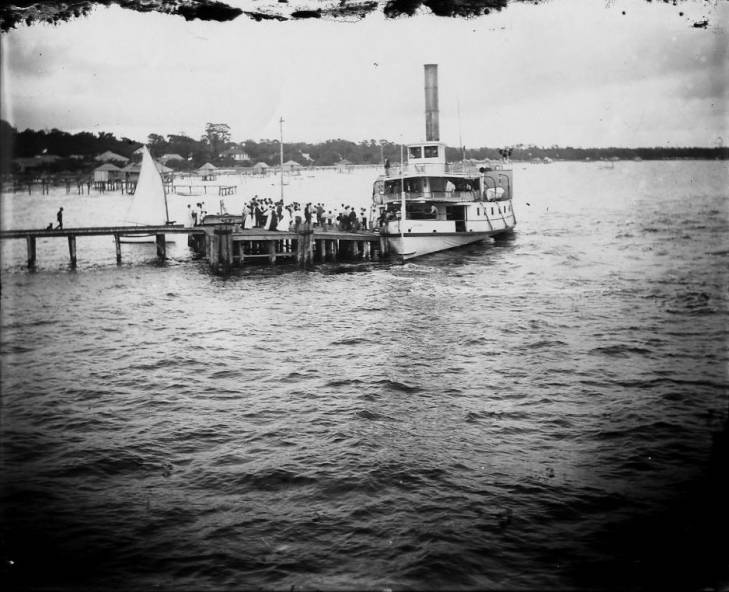
Bay Boat James Carney, 1905, Point Clear, Alabama. Historic Mobile Preservation Society, William E. Wilson Collection
My sister and I burst into laughter, pointing and guffawing at the uniformed men in Mobile, Alabama’s Bankhead Tunnel, constantly waving “come on” at our cars. We sped through it almost bumper-to-bumper as our father, driving, sped out of the city onto a causeway to go “over the Bay.” Why were they always waving at us? No car was pokey, and if one of us happened to break down, well, it was a narrow two-lane tunnel. It would be one huge traffic jam! For my sister and me, watching these men constantly waving their arms was entertaining.
“Over the Bay” is one of those expressions we Mobilians often use. It simply means crossing Mobile Bay for a visit on the Eastern Shore—to a beach, to visit a friend, a restaurant, a town, etc.
Before 1927, the year the bridges and the Causeway opened, people traveled to the Eastern Shore via bay boat. These boats, like the one pictured above, brought goods to those who lived on the Bay’s Eastern Shore as well as passengers. Toll rates ranged from $3.50 to $6.00 per person. One tragic event happened on a Sunday in 1871 when a bay boat, the Ocean Wave, exploded, killing an untold number of people. Later estimates put the number of deaths at close to 100.
Boat person that I am, I enjoyed using a bay boat as a setting in one of my chapters. Mobile Bay is beautiful, especially at sunrise and sunset!
Later, the Bankhead Tunnel was built. Nowadays, the city has two, more heavily-used tunnels.
As for me, whenever I visit my hometown I always drive the Causeway through the old Bankhead. No longer is it bumper-to-bumper, and numerous fond memories flood my mind. I only wish I’d been able to take a bay boat “over the Bay,” at least once in my lifetime.








 The Author's Cove: John "Jack" Cunningham on Writing & History